











How to Choose the Right Diamond Grinding Shoes for Concrete
Choosing the correct diamond grinding shoes can make the difference between fast, consistent concrete removal and hours of slow grinding, excessive tool wear and unnecessary costs.
The right grinding shoe depends on more than grit size. You must consider the hardness of the concrete, the coating being removed, the required finish, your grinder and the number of segments on each shoe.
This guide explains how to select the right Ballistic Diamond Tools grinding shoes, available from Diamond Tool Warehouse.
1. Identify the Application
Before selecting a diamond grinding shoe, determine exactly what you need to accomplish.
Common applications include:
- Removing paint, glue, epoxy or waterproofing
- Grinding high spots and uneven concrete
- Removing rain-damaged or weak concrete
- Preparing a floor for epoxy or another coating
- Exposing aggregate
- Removing scratches during concrete polishing
- Refining a floor before switching to resin polishing pads
Standard metal-bond diamond shoes are designed primarily for grinding concrete. If the floor has a heavy coating, thick adhesive or waterproofing membrane, a Gold Ballistic PCD shoe will usually be more effective.
Trying to remove thick coatings with standard diamond segments can cause the tooling to glaze, generate excessive heat and waste valuable time.
2. Match the Bond to the Concrete
Choosing the correct bond is one of the most important—and most commonly misunderstood—parts of selecting diamond grinding shoes.
The bond is the metal matrix that holds the diamonds in place. It must wear at the correct rate to expose fresh diamonds while grinding.
Hard concrete requires a softer bond
Hard concrete does not wear away the metal matrix quickly. A softer bond allows worn diamonds to be released so that new, sharp diamonds remain exposed.
If you use a hard-bond shoe on extremely hard concrete, the segment may glaze. The grinder can continue running while achieving very little material removal.
Soft concrete requires a harder bond
Soft concrete is normally more abrasive and can wear diamond tooling very quickly. A harder bond holds the diamonds in place longer and helps prevent premature segment wear.
A soft-bond shoe may initially cut well on soft concrete, but the segments can wear out extremely quickly.
The basic rule is:
Hard concrete requires a softer bond. Soft concrete requires a harder bond.
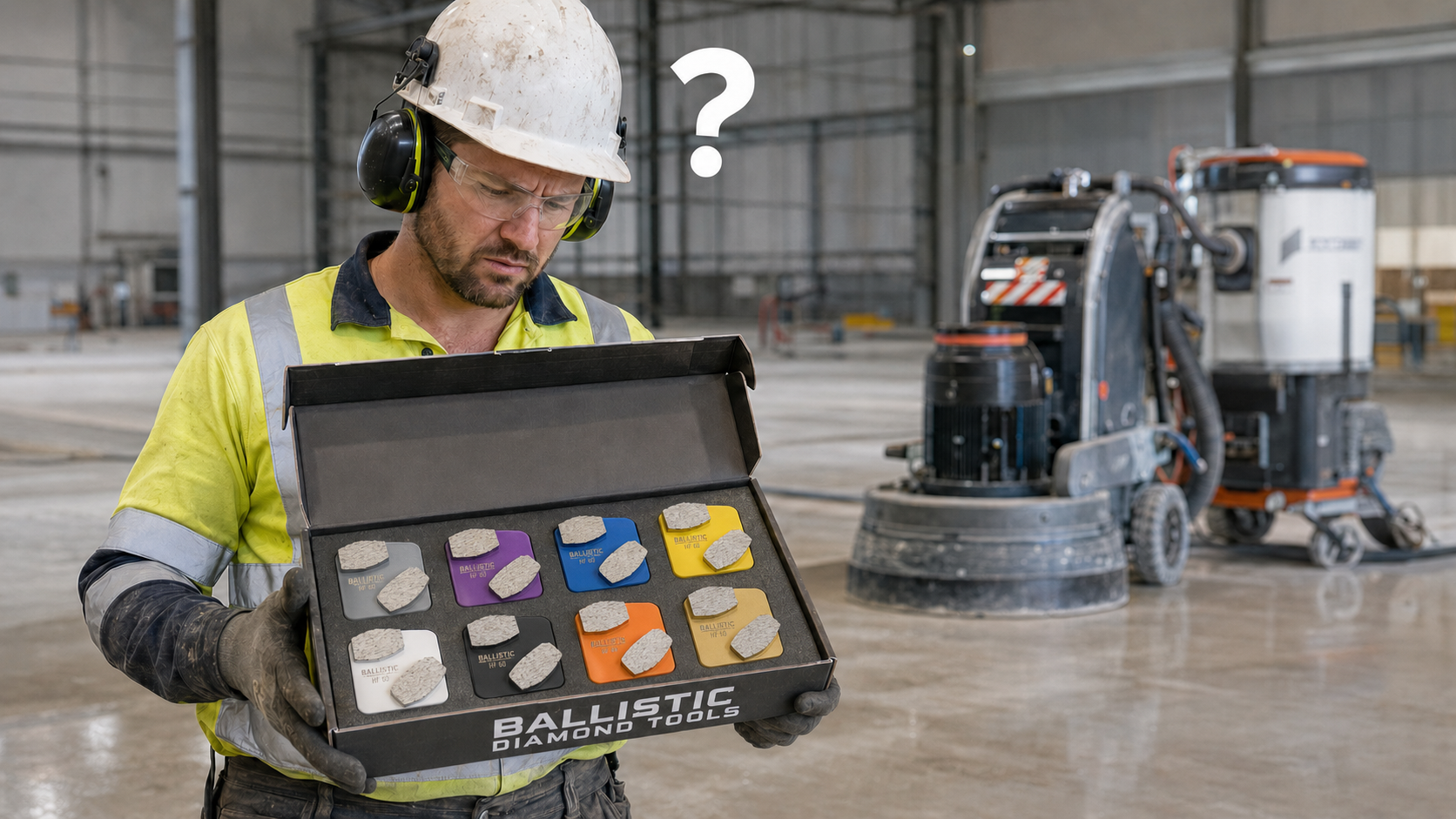
3. Ballistic Diamond Tools Colour Guide
Diamond Tool Warehouse supplies Ballistic Diamond Tools, with each grinding shoe colour-coded to make selecting the correct bond easier.
| Ballistic colour | Recommended floor type |
|---|---|
| Grey | Exceptionally hard concrete floors |
| Purple | Extremely hard concrete floors |
| Blue | Very hard concrete floors |
| Yellow | Hard concrete floors |
| White | Medium-hardness concrete floors |
| Black | Soft concrete floors |
| Orange | Extremely soft or highly abrasive concrete, including exposed aggregate |
| Gold PCD | Coating, glue, adhesive and waterproofing removal |
Grey Ballistic Diamonds—Exceptionally Hard Concrete
Grey Ballistic grinding shoes are designed for exceptionally hard concrete floors where ordinary diamond tooling may struggle to cut.
If the grinder is running but achieving very little removal, or the segments are becoming smooth and glazed, the floor may require the specialised Grey bond.
Purple Ballistic Diamonds—Extremely Hard Concrete
Purple Ballistic grinding shoes are designed for extremely hard concrete. They help maintain diamond exposure and provide an effective cut on dense floors that can cause harder-bond tooling to glaze.
Blue Ballistic Diamonds—Very Hard Concrete
Blue Ballistic grinding shoes are suited to very hard concrete. They provide a balance between cutting performance and tooling life on dense commercial and industrial concrete floors.
Yellow Ballistic Diamonds—Hard Concrete
Yellow Ballistic shoes are a dependable choice for hard concrete floors. They are suitable when the slab is harder than average but does not require the more specialised Blue, Purple or Grey tooling.
White Ballistic Diamonds—Medium Concrete
White Ballistic grinding shoes are designed for medium-hardness concrete. They are a versatile option for many standard concrete grinding and floor-preparation projects.
When the hardness of the concrete is unknown, White may be a practical starting point. However, testing a small area is always recommended.
Black Ballistic Diamonds—Soft Concrete
Black Ballistic grinding shoes are designed for soft and abrasive concrete. Their harder bond holds the diamonds longer, helping reduce the rapid segment wear that can occur when softer-bond tooling is used on abrasive floors.
Orange Ballistic Diamonds—Extremely Soft Concrete and Exposed Aggregate
Orange Ballistic grinding shoes are designed for extremely soft, highly abrasive concrete and exposed-aggregate surfaces.
These floors can wear ordinary diamond tooling extremely quickly. The Orange bond provides increased wear resistance, helping deliver better tooling life on demanding abrasive surfaces.
Gold Ballistic PCD—Heavy Coating Removal
Gold Ballistic PCD shoes are used for removing materials from the surface rather than grinding the concrete itself.
They are suitable for removing:
- Thick epoxy coatings
- Glue and flooring adhesive
- Waterproofing membranes
- Paint and heavy coating build-up
- Bitumen and similar surface materials
After using Gold PCD shoes, follow with the appropriate Ballistic metal-bond grinding shoe to remove any remaining material and produce a consistent concrete surface profile.
PCD shoes may also be directional, so always confirm that the tooling matches the rotation direction of the grinder head.
4. Select the Right Diamond Grit
Diamond grit controls how aggressively the shoe cuts and the scratch pattern it leaves behind.
Lower grit numbers contain larger, more aggressive diamonds. Higher grit numbers produce a finer finish.
16–20 grit: extremely aggressive grinding
Coarse diamond tooling is suitable for:
- Heavy concrete removal
- Flattening uneven floors
- Removing deep surface contamination
- Exposing aggregate quickly
- Removing stubborn material after PCD coating removal
These grits cut quickly but leave a deep scratch pattern that must be removed during later grinding stages.
25–30 grit: general-purpose grinding
A 25 or 30 grit shoe is one of the most versatile choices for concrete contractors.
It can be used for:
- General concrete grinding
- Surface preparation
- Removing minor imperfections
- Opening concrete before applying a coating
- Beginning many concrete polishing systems
If you are unsure where to begin, a 30 grit metal-bond shoe is often a sensible starting point once the correct Ballistic bond colour has been selected.
50–60 grit: scratch removal and refinement
These grits are generally used after an aggressive first cut. They reduce the scratches left by coarse metal tooling and begin refining the surface.
80–120 grit: fine metal grinding
Higher-grit metal shoes are used when a smoother finish is required. They may also be used as a later step before transitioning to hybrid or resin-bond polishing tooling.
The correct grit progression depends on the condition of the floor and the required finish. Do not move to the next grit until the previous scratch pattern has been completely removed.
5. Choose Between Single and Double Segments
The number of segments affects the pressure applied to the floor and how aggressively the shoe grinds.
Single-segment shoes
With less surface area contacting the floor, single-segment shoes apply more pressure through each segment.
They are generally:
- More aggressive
- Effective on hard concrete
- Useful for faster material removal
- Suitable for smaller or lighter grinders that require additional cutting pressure
Double-segment shoes
Double-segment shoes distribute the grinder’s weight across a larger contact area.
They generally provide:
- Smoother operation
- Better grinder stability
- A more consistent scratch pattern
- Longer tooling life
- Good performance on medium and soft concrete
More segments do not automatically mean faster grinding. The grinder’s weight, power and available head pressure must also be considered.
6. Check That the Shoe Fits Your Grinder
Not every grinding shoe fits every floor grinder.
Common mounting systems include:
- Redi Lock-style slide-on shoes
- HTC-style wings
- Magnetic plates
- Bolt-on shoes
- Machine-specific adapter systems
Check the grinder’s tooling plate before ordering. If you are using adapter plates, confirm both the adapter and grinding shoe are securely fitted and suitable for the machine’s operating speed.
The tooling configuration should also suit the grinder. A small single-phase machine may perform better with fewer segments, while a heavy three-phase planetary grinder can generally operate more segments efficiently.
7. Consider Wet or Dry Grinding
Many metal-bond grinding shoes can be used wet or dry, but the chosen method will affect how the tooling performs.
Dry grinding offers:
- Easier waste collection
- Immediate visibility of the floor
- No concrete slurry
- Efficient operation when connected to a suitable dust extractor
Wet grinding can:
- Keep the tooling cooler
- Reduce airborne dust
- Help prevent glazing in some conditions
- Extend tooling life in certain applications
Wet grinding creates concrete slurry that must be contained and disposed of correctly. Always check whether the tooling and grinder are approved for the intended grinding method.
Concrete grinding can also generate hazardous respirable crystalline silica. Always use suitable dust extraction, respiratory protection and safe work practices that comply with current Australian workplace requirements.
Signs You Are Using the Wrong Grinding Shoe
Watch for these warning signs while grinding:
- The grinder is running but barely cutting
- The segments appear smooth or polished
- The tooling is wearing unusually quickly
- The machine is bouncing or vibrating excessively
- A thick coating is smearing across the floor
- The concrete is being gouged more deeply than intended
- The grinder is drawing excessive current or repeatedly tripping
- The previous scratch pattern remains visible after the next grinding step
Stop and inspect the tooling rather than continuing to grind inefficiently. Changing the Ballistic bond colour, grit or segment configuration could save hours of labour and unnecessary tooling costs.
Always Test a Small Area First
Concrete hardness can vary between projects—and even across different sections of the same slab.
The age of the concrete, aggregate, curing conditions, surface treatments and previous coatings can all affect grinding performance.
Start with a small test area and check:
- Material-removal speed
- Segment wear
- Grinder load
- Scratch pattern
- Surface finish
- Coating-removal performance
The cheapest grinding shoe is not necessarily the lowest-cost option. Labour, machine time, productivity and tooling life are more important than the shoe’s initial purchase price.
Get the Right Ballistic Diamond Tools from Diamond Tool Warehouse
Diamond Tool Warehouse supplies professional Ballistic Diamond Tools, including colour-coded metal-bond grinding shoes and Gold PCD coating-removal tooling for Australian concrete contractors.
If you are unsure which Ballistic shoe you require, contact our team with:
- Your grinder’s make and model
- The condition and hardness of the concrete
- The coating or material being removed
- The finish you need to achieve
- Whether you are grinding wet or dry
The Diamond Tool Warehouse team can help match the correct Ballistic bond colour, diamond grit, segment configuration and mounting system to your application—so you spend more time grinding and less time changing tools.