











Polyurethane vs Polyaspartic Flooring: Which Is the Better Choice?
Polyurethane and polyaspartic coatings are both commonly used as protective finishes for concrete floors. They can provide excellent durability, chemical resistance and visual appeal, but they behave very differently during installation.
Polyaspartic is often promoted as the newer and better option because it cures quickly and can offer strong UV stability. However, faster curing is not automatically better for every project.
A conventional polyurethane coating may provide more working time, easier application and a highly durable finish at a lower material cost. Polyaspartic can return a floor to service much faster, but its short working time can make installation considerably less forgiving.
The right choice depends on:
- Location and expected UV exposure
- Required return-to-service time
- Installer experience
- Floor area and complexity
- Application temperature
- Required chemical and abrasion resistance
- Desired appearance
- Product cost
- Complete flooring-system design
This guide explains the practical differences between polyurethane and polyaspartic flooring.
What Is Polyurethane Flooring?
Polyurethane—also known as urethane—is a broad category of polymer coating rather than one single product.
Flooring-grade polyurethane coatings are generally used as protective topcoats over:
- Epoxy flooring
- Decorative flake systems
- Coloured resin floors
- Polished or decorative concrete
- Cementitious flooring systems
- Existing compatible coatings
Polyurethane floor coatings are available in different formulations, including:
- Water-based polyurethane
- Solvent-based polyurethane
- Aliphatic polyurethane
- Aromatic polyurethane
- Single-component products
- Two-component products
- Clear or pigmented finishes
- Gloss, satin or matt finishes
These products can perform very differently. It is therefore inaccurate to assume that every polyurethane coating has the same UV stability, chemical resistance, cure time or application thickness.
Always assess the specific product—not only the word “polyurethane” on the label.
What Is Polyaspartic Flooring?
Polyaspartic coatings are a type of aliphatic polyurea technology developed to provide fast curing while maintaining a more manageable application time than traditional rapid-cure polyurea systems.
Polyaspartic coatings are commonly used for:
- Garage floors
- Workshops
- Retail flooring
- Commercial kitchens
- Warehouses
- Decorative flake systems
- Showrooms
- External covered areas
- Fast-turnaround commercial projects
They can be used as:
- Primers
- Body coats
- Flake broadcast coats
- Clear topcoats
- Pigmented topcoats
However, not every polyaspartic product is suitable for every layer of a flooring system. Some are designed primarily as topcoats, while others are formulated for complete rapid-cure systems.
Polyurethane vs Polyaspartic: Quick Comparison
| Feature | Polyurethane | Polyaspartic |
|---|---|---|
| Working time | Generally longer | Generally shorter |
| Cure speed | Moderate | Very fast |
| Return to service | Usually slower | Usually faster |
| UV stability | Good with suitable aliphatic products | Commonly very good |
| Application difficulty | More forgiving | Less forgiving |
| Temperature flexibility | Product dependent | Often wider, but product dependent |
| Material cost | Generally lower | Generally higher |
| Large-floor application | Easier working time | Requires careful planning and labour |
| Decorative flake topcoat | Commonly used | Commonly used |
| Recoat window | Generally longer | Can be very short |
| DIY suitability | More manageable with the right product | Usually more difficult |
| Moisture sensitivity | Product dependent | Product dependent and can be significant |
This comparison is general. The technical data sheet for the selected product remains the final authority.
Cure Speed
The most obvious difference is cure speed.
Polyurethane
Many polyurethane coatings provide a reasonable working time before they begin to set. This gives the installer more time to:
- Mix the components
- Cut in around edges
- Roll the material evenly
- Maintain a wet edge
- Correct roller marks
- Apply non-slip aggregate
- Work around columns and equipment
Depending on the product and conditions, the floor may require a longer period before recoating, foot traffic or vehicle traffic.
Polyaspartic
Polyaspartic coatings can cure extremely quickly. Some systems allow multiple coats to be applied in one day and may return a floor to service much sooner than conventional systems.
This can be valuable for:
- Commercial businesses with limited shutdown time
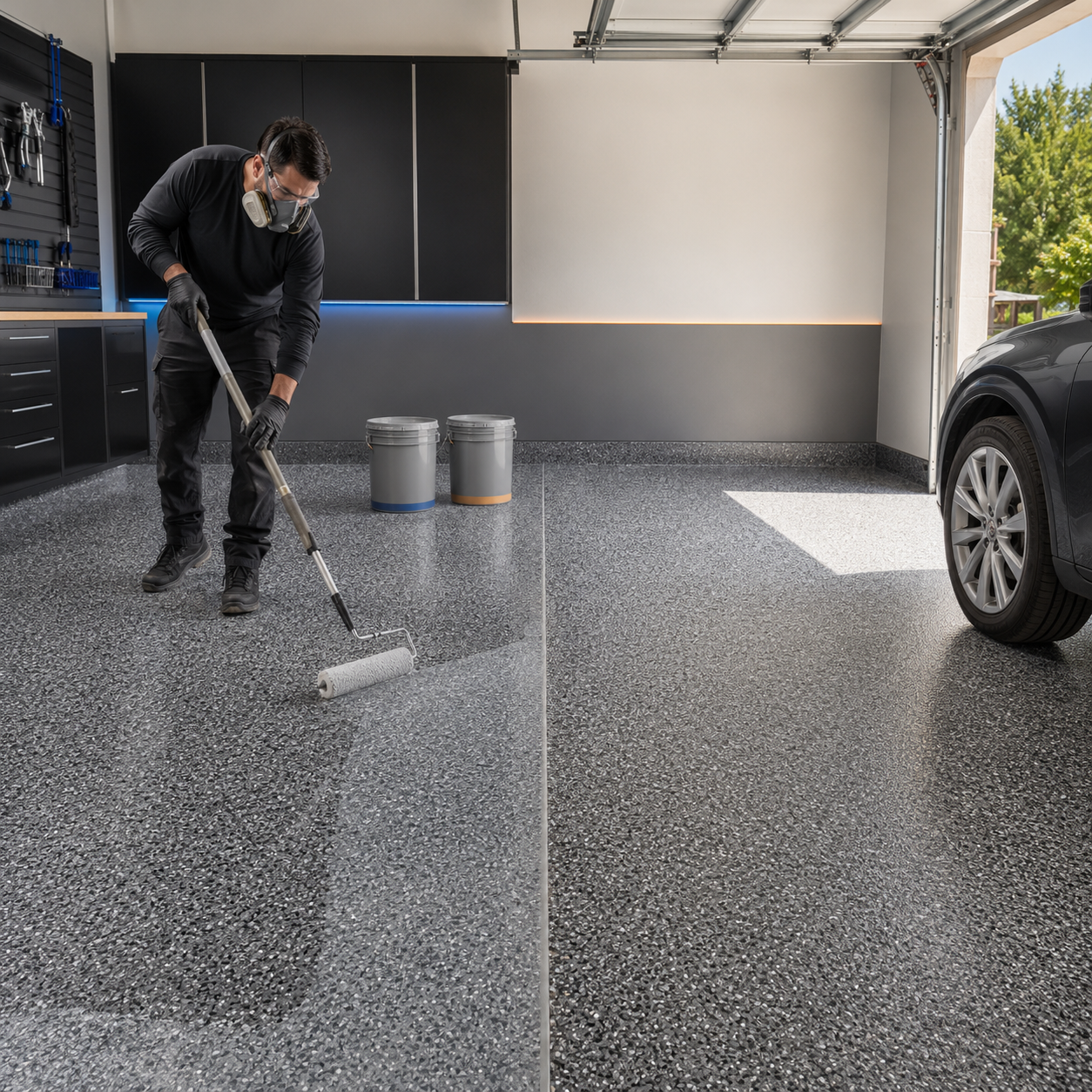
- Garage floors that need rapid completion
- Retail spaces
- Workshops
- Food-processing facilities
- Time-sensitive refurbishment projects
The trade-off is reduced working time.
Once mixed, the installer may have only a limited period to spread and finish the material. A small delay, incorrect mix size or slow application can result in roller marks, overlaps or material curing inside the bucket.
Working Time and Application Difficulty
Longer working time generally makes polyurethane more forgiving.
This can be particularly important when the floor has:
- Complicated edges
- Multiple rooms
- Columns
- Drains
- Machinery bases
- Stairs
- Numerous penetrations
- Hot application conditions
- Limited labour
Polyaspartic systems demand better organisation.
Before mixing, the installer should have:
- The floor completely prepared
- All materials measured and ready
- Rollers and brushes unpacked
- A planned application path
- Enough workers for the floor area
- Correct footwear
- Spiked rollers where specified
- Non-slip aggregate ready
- A clear exit route
- Backup equipment available
Fast curing is an advantage only when the crew can apply the material correctly within its working time.
Pot Life Is Not the Same as Working Time
A coating may appear fluid inside the mixing container while becoming difficult to apply correctly on the floor.
The usable working time can be affected by:
- Product temperature
- Concrete temperature
- Air temperature
- Humidity
- Mixed quantity
- Container shape
- Direct sunlight
- Application thickness
Leaving mixed material inside a deep bucket can accelerate heat development. The coating may cure much faster than expected.
Never assume the published pot life provides the same amount of practical rolling time. Follow the manufacturer’s mixing and application instructions precisely.
UV Stability and Yellowing
UV resistance is one of the major reasons polyurethane and polyaspartic coatings are used as topcoats.
Many epoxy coatings can amber or yellow when exposed to sunlight. This is particularly noticeable over:
- Light-coloured flakes
- White flooring
- Grey decorative systems
- Clear finishes
- Areas near open doors
- Floors exposed through windows
Aliphatic Polyurethane
A suitable aliphatic polyurethane can offer very good UV stability and help protect the colour and appearance of the flooring system.
Aromatic polyurethane products may not provide the same colour stability, so the exact formulation matters.
Polyaspartic
Polyaspartic coatings are commonly based on aliphatic chemistry and can provide excellent resistance to yellowing.
This makes them a popular choice for:
- Garage entrances
- Areas receiving natural light
- Decorative flake floors
- Clear topcoats
- Covered external areas
UV stability does not mean the complete flooring system is automatically suitable for permanent outdoor exposure. The primer, body coat, pigments, flakes and substrate conditions must also be considered.
Abrasion and Wear Resistance
Both polyurethane and polyaspartic coatings can provide strong abrasion resistance when correctly specified and applied.
Performance depends on:
- Formulation
- Applied thickness
- Cure conditions
- Surface preparation
- Number of coats
- Traffic type
- Cleaning methods
- Added non-slip aggregate
- Maintenance
A high-quality polyurethane may outperform a lower-quality polyaspartic product, and the reverse may also be true.
Product category alone does not determine durability.
Ask for comparable test data where wear resistance is critical. Ensure the figures were produced using the same test method before making direct comparisons.
Chemical Resistance
Both coating types can resist many common chemicals, but neither should be described as universally chemical-proof.
Exposure may include:
- Petrol
- Diesel
- Engine oil
- Brake fluid
- Cleaning chemicals
- Acids
- Alkalis
- Solvents
- Food products
- Hot tyre contaminants
Chemical resistance depends on:
- Product formulation
- Chemical concentration
- Exposure time
- Temperature
- Whether spills are cleaned quickly
- Coating thickness
- Degree of cure
A brief splash is different from permanent immersion.
For workshops, commercial kitchens and industrial floors, check the manufacturer’s chemical-resistance chart against the actual substances used at the site.
Hot-Tyre Resistance
Garage-floor coatings are often marketed as “hot-tyre resistant,” but tyre-related marking and lifting can involve several factors.
Possible causes include:
- Poor surface preparation
- Weak concrete
- Incorrect primer
- Contamination
- Insufficient cure
- Low coating thickness
- Incompatible layers
- Plasticiser migration from tyres
- Driving onto the floor too early
Both polyurethane and polyaspartic topcoats can perform well in garages when installed as part of a properly designed system.
A premium topcoat cannot compensate for a poorly bonded primer or inadequately prepared concrete underneath it.
Application Thickness
Polyurethane coatings are often applied as relatively thin protective topcoats. Applying them more heavily than specified can cause problems such as:
- Bubbling
- Solvent entrapment
- Slow curing
- Foaming
- Uneven appearance
- Reduced performance
Polyaspartic coatings may allow higher application rates depending on the formulation, but they still have defined minimum and maximum coverage requirements.
Coverage should be calculated from the specified application rate—not guessed from how the floor looks while rolling.
For example:
Floor area ÷ coverage per kit = number of kits required
If a kit covers 30 m² and the floor is 72 m²:
72 ÷ 30 = 2.4 kits
You cannot purchase 0.4 of a kit, so at least three kits are required before allowing for waste, edges and surface texture.
Always calculate material requirements before beginning. Running out halfway through a fast-curing polyaspartic application can leave a permanent join or visible overlap.
Surface Preparation
Neither polyurethane nor polyaspartic should be applied over poorly prepared concrete.
The floor may require:
- Diamond grinding
- Shot blasting
- Coating removal
- Oil and contamination treatment
- Crack repair
- Joint preparation
- Thorough H-class vacuuming
- Moisture testing
The required surface profile depends on the coating and flooring system.
If the product is being applied over an existing coating, confirm:
- The existing coating is firmly bonded
- It is chemically compatible
- It is clean and uncontaminated
- It has been mechanically abraded as specified
- The recoat window has not been exceeded
A coating failure between layers is still a preparation failure, even when the concrete underneath remains sound.
Moisture and Humidity
Moisture can affect both polyurethane and polyaspartic systems.
Potential problems include:
- Bubbling
- Foaming
- Cloudiness
- Pinholes
- Loss of adhesion
- Uneven gloss
- Delamination
Some rapid-cure coatings are particularly sensitive to moisture during application. High humidity, condensation or moisture in the concrete can interfere with the reaction.
Do not assume that a fast-cure product can safely trap or overcome slab moisture.
Check:
- Concrete moisture limits
- Relative humidity
- Dew point
- Surface temperature
- Air temperature
- Manufacturer’s environmental limits
The concrete surface should normally remain sufficiently above the dew point to avoid condensation, in accordance with the selected product’s requirements.
Temperature and Weather Conditions
Polyaspartic coatings are often promoted for application across a wider temperature range. This can be useful in cold conditions, but temperature still affects working time and cure.
In hot weather, polyaspartic material may cure much faster than expected.
This can lead to:
- Roller lines
- Lap marks
- Uneven texture
- Bubbles
- Material setting in the bucket
- Poor connection between application sections
Polyurethane may provide more manageable working time in warm conditions, although excessive heat can still affect application.
Control the conditions where possible and avoid applying coatings to concrete heated by direct sunlight unless permitted by the manufacturer.
Appearance and Finish
Both systems are available in clear and pigmented versions with different gloss levels.
They can be used to create:
- Gloss finishes
- Satin finishes
- Matt finishes
- Decorative flake floors
- Coloured floors
- Non-slip finishes
- Clear protective coats
Polyaspartic coatings can produce a clear, high-gloss appearance that enhances decorative flake systems.
Polyurethane is often chosen when a softer satin or matt finish is desired, although available options depend on the product range.
Appearance can also be affected by application technique. A fast-cure clear coat may show overlaps or roller patterns if it is not applied efficiently.
Slip Resistance
Smooth polyurethane and polyaspartic floors can become slippery, particularly when wet or contaminated with oil.
Slip resistance can be increased by incorporating or broadcasting suitable aggregate into the coating system.
Possible aggregates include:
- Fine polymer particles
- Aluminium oxide
- Silica-based aggregates
- Specialised non-slip additives
More aggregate can improve grip but may also:
- Make the floor harder to clean
- Trap dirt
- Reduce gloss
- Increase roller drag
- Require more coating material
- Create a rougher surface
Slip resistance should be selected according to the environment rather than added as an afterthought.
Recoat Windows
Every coating has a defined period during which the next layer can be applied without additional preparation.
Polyaspartic recoat windows can be particularly short because of the rapid cure.
If the maximum window is exceeded, the surface may require mechanical abrasion before another coat is applied.
Failing to observe the recoat window can cause intercoat adhesion failure even when each individual coating appears properly cured.
Record:
- Mixing time
- Application start time
- Application finish time
- Floor temperature
- Air temperature
- Time of the next coat
On larger projects, accurate records help keep the installation within specification.
Cost Comparison
Polyaspartic coatings generally cost more per litre or kit than conventional polyurethane coatings.
However, material price is only one part of the project cost.
Polyaspartic may reduce:
- Return visits
- Overnight curing delays
- Business shutdown time
- Accommodation and travel costs
- Labour across multiple days
- Equipment-hire periods
Polyurethane may be more economical when:
- Rapid reopening is not required
- The project has a flexible schedule
- The installer needs longer working time
- The floor is large or complicated
- Material cost is a major consideration
The least expensive coating per kit is not necessarily the lowest-cost installed system.
Which Is Better for Garage Floors?
Both can be excellent garage-floor topcoats.
Consider Polyurethane When:
- A longer working time is preferred
- The installer is less experienced
- The floor has complicated edges
- Rapid return to service is not essential
- A satin or matt finish is required
- Material cost needs to be controlled
- The selected polyurethane offers suitable UV and chemical resistance
Consider Polyaspartic When:
- Fast return to service is important
- Multiple coats must be completed quickly
- Strong UV stability is required
- An experienced installation crew is available
- A clear, high-gloss flake-system finish is desired
- The project can support the higher material cost
- Temperature and humidity are within the product’s limits
For many garage floors, a practical system may use an epoxy primer or body coat followed by a polyurethane or polyaspartic topcoat.
The topcoat should be compatible with every layer beneath it.
Which Is Better for Commercial Floors?
The answer depends on the type of business.
Polyaspartic may be valuable for:
- Retail stores
- Commercial workshops
- Showrooms
- Businesses unable to close for several days
- Fast refurbishment projects
Polyurethane may be preferable for:
- Large floors requiring more application time
- Projects where shutdown time is less critical
- Facilities requiring a specific satin or matt finish
- Installations with complicated layouts
- Projects with tighter material budgets
For heavy industrial environments, neither should be selected without confirming the required chemical, thermal and mechanical performance.
Is Polyaspartic Always Better?
No.
Polyaspartic provides real advantages, particularly cure speed and UV stability. But its short working time can increase installation risk.
A rushed or poorly applied polyaspartic system will not outperform a correctly selected and professionally installed polyurethane system.
Polyaspartic is not automatically:
- More chemical resistant
- More abrasion resistant
- More strongly bonded
- More suitable for moisture
- Better for every climate
- Easier to install
- Suitable over every primer
- Appropriate for every DIY project
The formulation and complete system matter more than the marketing category.
Can DIY Users Apply Polyaspartic Flooring?
It is possible, but polyaspartic coatings are less forgiving than many conventional coatings.
Common DIY risks include:
- Mixing too much material
- Underestimating the working time
- Failing to maintain a wet edge
- Running out of material
- Incorrect application thickness
- Poor floor preparation
- Applying in unsuitable conditions
- Missing the recoat window
A polyurethane product with a longer working time may be a more manageable option for an inexperienced installer.
DIY users should never choose a product based only on rapid cure. Fast curing also means less time to correct mistakes.
Questions to Ask Before Choosing
Before selecting polyurethane or polyaspartic, determine:
- Is the floor indoors, outdoors or exposed through open doors?
- How quickly must it return to service?
- What chemicals will contact the floor?
- Will vehicles or forklifts use the area?
- Is gloss, satin or matt preferred?
- Is a non-slip finish required?
- What are the expected application conditions?
- Is the installer experienced with rapid-cure coatings?
- What primer and body coat will be used?
- Are all system layers compatible?
- What is the required coverage rate?
- What are the minimum and maximum recoat windows?
- Has the concrete been moisture tested?
- What surface profile is specified?
- Is current technical documentation available?
Flooring Preparation Equipment from Diamond Tool Warehouse
Correct coating selection is only part of a successful flooring project. The concrete must also be properly prepared.
Diamond Tool Warehouse supplies professional equipment and tooling for floor preparation, including:
- Diamond grinding shoes
- PCD coating-removal tools
- Diamond cup wheels
- Floor grinders
- Edge-grinding equipment
- H-class dust extractors
- Dust hoses and adapters
- Continuous dust bags
- Concrete preparation and repair equipment
Before applying any polyurethane or polyaspartic system, confirm the coating manufacturer’s current requirements for surface preparation, moisture, coverage and application conditions.
Final Verdict
Choose polyurethane when you want longer working time, a more forgiving application and potentially lower material cost.
Choose polyaspartic when rapid curing, fast return to service and strong UV stability are major priorities—and the installer has the experience to manage its shorter working time.
Neither option is automatically superior.
A correctly specified polyurethane floor can outperform an unsuitable polyaspartic installation. Likewise, a properly installed polyaspartic system can dramatically reduce project downtime while delivering an attractive and durable finish.
The best coating is the one that suits the floor, environment, installation conditions and complete system—not simply the product with the fastest cure or strongest marketing claims.
For help selecting concrete surface-preparation equipment before installing a flooring system, contact the team at Diamond Tool Warehouse.