












Which Tool Should You Use for Concrete Floor Preparation?
If you’ve ever stood in front of a concrete floor wondering whether to install PCD grinding shoes or diamond grinding shoes, you’re not alone.
It’s one of the most common questions flooring contractors ask, and choosing the wrong tooling can cost hundreds of dollars in wasted diamonds, lost time and unnecessary labour.
The simple answer is this:
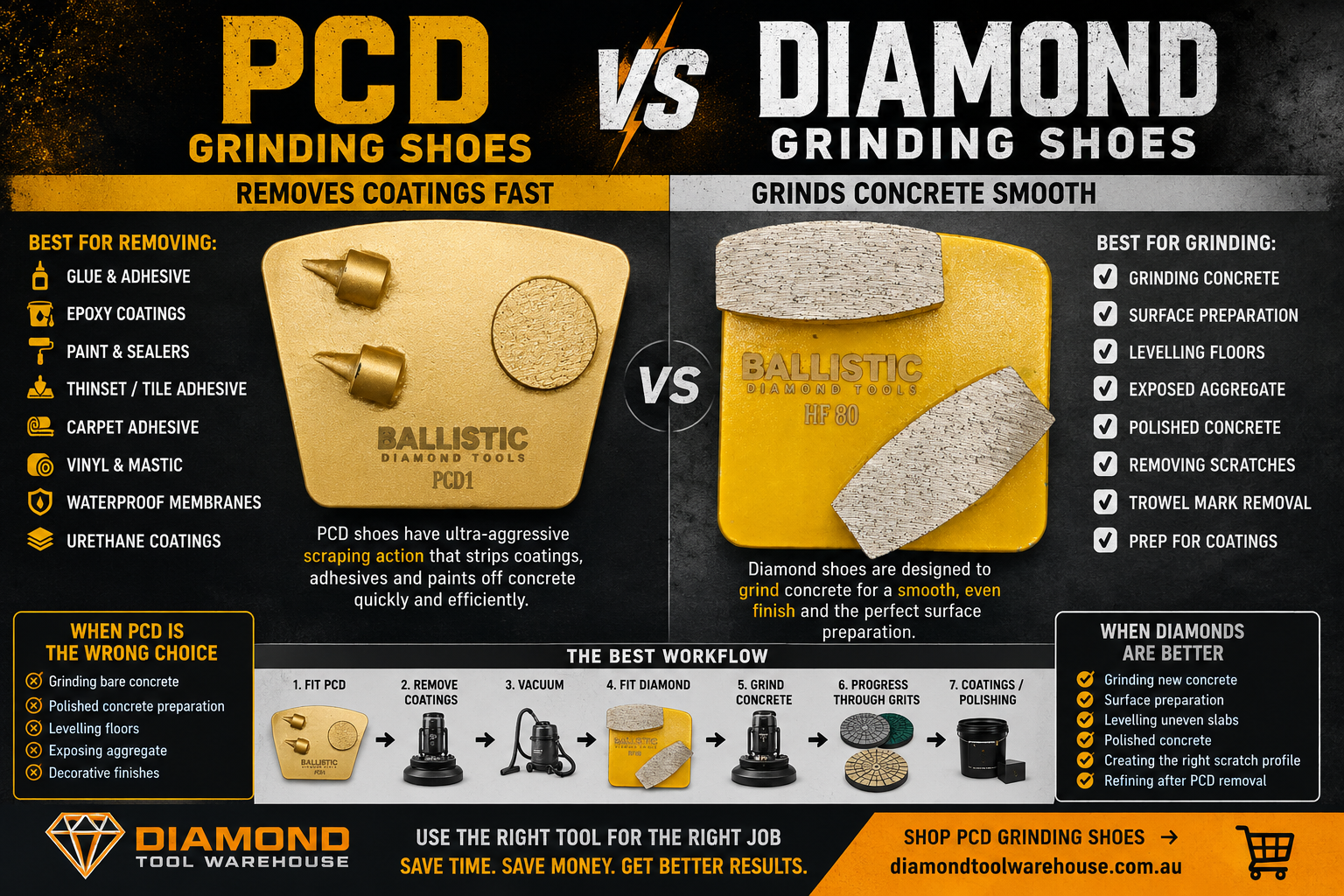
- PCD grinding shoes remove coatings.
- Diamond grinding shoes grind concrete.
However, knowing when to use each tool is what separates experienced contractors from beginners.
This guide explains exactly where each tool excels, when each one should be avoided, and how to achieve the fastest and most cost-effective results.
What Are PCD Grinding Shoes?
PCD stands for Polycrystalline Diamond.
Unlike traditional diamond grinding segments that wear away concrete, PCD inserts act more like extremely aggressive scrapers.
Instead of grinding the slab itself, they rip coatings away from the surface with incredible speed.
Because of this aggressive action, PCD tooling has become the industry standard for removing:
- Thick epoxy coatings
- Glue and carpet adhesive
- Tile adhesive (thinset)
- Paint
- Waterproof membranes
- Urethane coatings
- Mastic
- Vinyl adhesive
- Rubber-backed flooring residue
Rather than polishing or grinding the slab, PCD tools are designed to strip unwanted materials off the concrete as quickly as possible.
What Are Diamond Grinding Shoes?
Diamond grinding shoes use industrial diamond segments embedded in a metal bond.
Instead of tearing coatings away, they grind concrete itself.
Their main jobs include:
- Opening concrete
- Surface preparation
- Removing high spots
- Levelling slabs
- Grinding exposed aggregate
- Preparing for polished concrete
- Removing laitance
- Producing a consistent scratch pattern before polishing or coatings
Different bonds and grit sizes allow contractors to match the tooling to both the hardness of the concrete and the desired finish.
PCD vs Diamond Shoes
| Job | Best Choice |
|---|---|
| Thick epoxy removal | PCD |
| Glue removal | PCD |
| Carpet adhesive | PCD |
| Paint removal | PCD |
| Tile thinset removal | PCD |
| Concrete grinding | Diamond Shoes |
| Exposed aggregate | Diamond Shoes |
| Surface levelling | Diamond Shoes |
| Concrete polishing | Diamond Shoes |
| Removing scratches | Diamond Shoes |
Glue Removal
Glue removal is where PCD tooling shines.
Old carpet adhesive, vinyl glue and black mastic can quickly clog conventional diamond segments.
Instead of cutting efficiently, standard diamonds often “gum up,” slow down and generate excess heat.
PCD shoes slice underneath the adhesive and lift it away from the concrete rather than trying to grind through it.
The result is:
- Faster removal
- Longer tool life
- Less loading
- Lower labour costs
Once the glue has been removed, contractors normally switch to metal-bond diamond shoes to clean the slab and prepare it for polishing or coatings.
Epoxy Removal
Removing thick epoxy coatings using ordinary diamond shoes can take hours.
Because epoxy softens with heat, conventional diamonds often smear the coating across the floor instead of removing it.
PCD tooling is specifically designed for this job.
Its aggressive scraping action breaks the coating away rapidly, exposing the concrete underneath with far less effort.
Paint Removal
Paint can be surprisingly difficult to remove with standard grinding shoes.
Thin paint layers often heat up before they grind away, causing loading and reducing cutting efficiency.
PCD tools remove:
- Acrylic paint
- Industrial coatings
- Line marking paint
- Warehouse coatings
- Floor sealers
much faster than conventional diamond tooling.
Removing Thinset
Tile adhesive (thinset) is one of the toughest flooring materials contractors encounter.
Depending on the product used, thinset may contain:
- Sand
- Cement
- Polymer additives
- Fibre reinforcement
Grinding it away with ordinary diamonds usually causes rapid wear.
PCD shoes can remove the bulk of the thinset quickly.
Afterwards, diamond grinding shoes are used to flatten the remaining residue and restore a clean, even concrete surface.
When PCD Is the Wrong Choice
One of the biggest mistakes contractors make is trying to use PCD tooling as an all-purpose grinding shoe.
It isn’t.
PCD tools should not be used for:
Grinding Bare Concrete
PCD is designed to remove coatings, not concrete.
Once the slab is exposed, it becomes slow, rough and inefficient.
Polished Concrete Preparation
PCD leaves an aggressive, uneven surface.
If you’re planning to polish concrete, you should switch to metal-bond diamond shoes immediately after the coating has been removed.
Levelling Floors
Need to remove lippage?
Need to flatten a slab?
Need to expose aggregate?
Use metal-bond diamond shoes.
They grind evenly across the floor and produce a controlled scratch pattern suitable for the next grinding stage.
Decorative Finishes
If the finished floor matters, diamond shoes always produce a better, more consistent result.
When Diamond Grinding Shoes Are Better
Diamond shoes are the correct choice whenever the job involves the concrete itself rather than what’s sitting on top of it.
Choose metal-bond diamond shoes for:
- Grinding new concrete
- Surface preparation
- CSP profile creation
- Exposed aggregate
- Polished concrete
- Levelling uneven slabs
- Scratch removal
- Removing trowel marks
- Preparing for epoxy installation
- Refining surfaces after PCD removal
They provide controlled cutting, predictable scratch patterns and the foundation needed for high-quality floor finishes.
The Best Workflow
Professional contractors rarely use only one type of tooling.
Instead, they combine both.
A typical coating removal project looks like this:
- Fit PCD grinding shoes.
- Remove glue, epoxy, paint or thinset.
- Vacuum thoroughly.
- Switch to metal-bond diamond shoes.
- Grind the concrete to remove PCD scratch marks.
- Continue through finer grits if polishing.
- Apply coatings or densifiers as required.
Using each tool for the job it was designed to do saves time, extends tool life and produces a much better finished floor.
Which Tool Should You Buy?
If you’re regularly removing:
- Epoxy
- Glue
- Thinset
- Paint
- Waterproofing membranes
- Vinyl adhesive
start with PCD grinding shoes.
If you’re grinding concrete, exposing aggregate, levelling slabs or preparing a floor for polishing, choose metal-bond diamond grinding shoes.
Many professional contractors keep both in the trailer because almost every floor preparation project requires each tool at different stages.
Find the Right PCD and Diamond Tooling at Diamond Tool Warehouse
At Diamond Tool Warehouse, we stock professional-grade PCD grinding shoes and metal-bond diamond grinding shoes for all major floor grinding machines.
Whether you’re removing stubborn coatings or preparing concrete for polishing, our team can recommend the correct bond, grit and tooling combination for your machine and the concrete you’re working on.
Browse our full range of PCD grinding shoes and find the right solution for your next floor preparation project at www.diamondtoolwarehouse.com.au.