













Creating a clean, consistent profile on a concrete edge can take far longer than expected when you’re trying to do it freehand.
A small mistake with the grinder angle can create an uneven radius. Take too much material from one section and you’re suddenly spending more time trying to blend the entire edge back together.
For contractors regularly working on concrete benchtops, precast concrete, stairs, slabs, polished concrete and architectural concrete, there is a much easier solution.
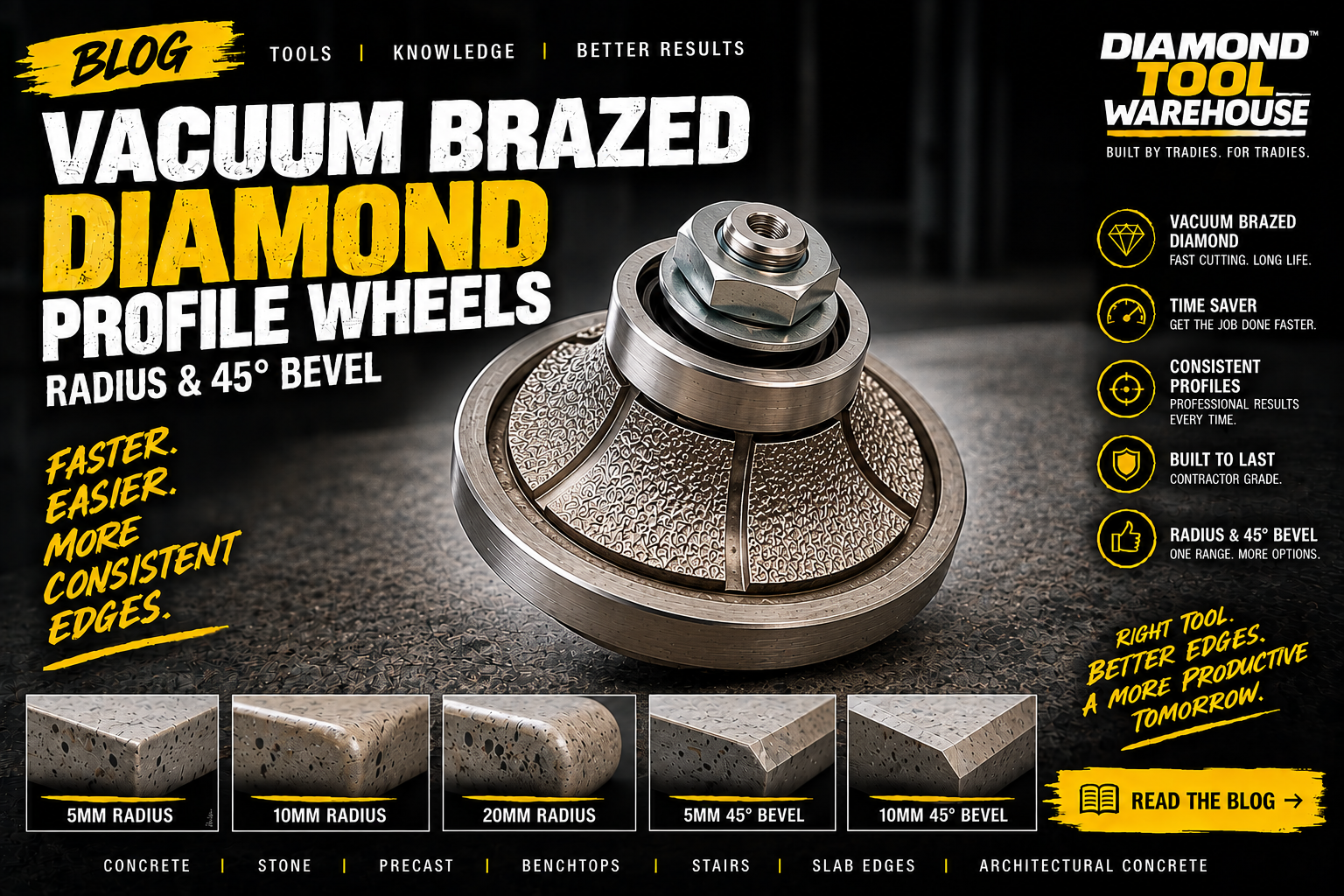
Vacuum Brazed Diamond Hand Grinder Profile Wheels are purpose-built for creating controlled radius and 45° bevel profiles using a compatible 5″ (125mm) handheld grinder.
Instead of trying to manually reproduce the same shape along an entire edge, the profile is built directly into the diamond wheel.
The result?
Faster profiling, less freehand grinding, fewer corrections and more consistent edges.
What Is a Diamond Profile Wheel?
A diamond profile wheel is a specialised diamond grinding tool designed to create a predetermined shape along the edge of concrete, stone or other suitable masonry materials.
Unlike a conventional grinding wheel, which relies heavily on the operator to manually create the required shape, a profile wheel has the desired radius or bevel geometry built into the wheel itself.
Our Vacuum Brazed Diamond Profile Wheel range includes:
| Profile | 30 Grit | 60 Grit | 120 Grit |
|---|---|---|---|
| 5mm Radius | ✓ | ✓ | ✓ |
| 10mm Radius | ✓ | ✓ | ✓ |
| 20mm Radius | ✓ | ✓ | ✓ |
| 5mm 45° Bevel | ✓ | ✓ | — |
| 10mm 45° Bevel | ✓ | ✓ | — |
That provides 13 profile and grit combinations for everything from aggressive initial shaping through to finer radius refinement.
Why Vacuum Brazed Diamond?
The cutting surface of these profile wheels uses vacuum brazed diamond technology.
During manufacturing, industrial diamond particles are bonded to the metal working surface using a specialised brazing process.
One of the major advantages of this construction is high diamond exposure.
The exposed diamond particles can engage directly with the material being worked, providing the aggressive cutting action needed when physically changing the shape of a concrete or stone edge.
This makes vacuum brazed tooling particularly useful for:
- Edge shaping
- Material removal
- Radius creation
- Bevel creation
- Chamfering
- Profile refinement
Rather than being designed primarily to polish a surface, these wheels are designed to cut and shape it.
Why Diamond Profile Wheels Can Save Contractors So Much Time
This is where profile wheels really start to make sense.
Imagine you need to create a consistent 10mm radius along a concrete edge.
Using conventional grinding tooling, you may have to:
- Remove the original sharp corner.
- Begin shaping the radius freehand.
- Check the profile.
- Correct high spots.
- Blend low spots.
- Check the radius again.
- Continue working along the entire edge.
- Go back and correct inconsistent areas.
Even experienced operators can spend significant time making sure the profile looks consistent.
A dedicated 10mm Radius Diamond Profile Wheel already contains the required geometry.
Instead of trying to create the shape entirely by eye, the tooling helps establish it for you.
That can mean substantially less time spent shaping and correcting.
Time Saved Means Money Saved
For contractors, labour is expensive.
Saving even 15 or 20 minutes on individual edges can become significant when profiling:
- Multiple stairs
- Long benchtops
- Precast components
- Repetitive slab edges
- Multiple architectural details
The real value of specialised diamond tooling isn’t simply how quickly it cuts.
It’s the unnecessary labour it can eliminate.
More Consistent Edges
Speed isn’t much use if the finished result looks terrible.
One of the biggest challenges with freehand edge profiling is maintaining exactly the same grinder angle and material removal along the entire edge.
A slight change in hand position can alter the profile.
Profile wheels reduce this dependence on freehand shaping by providing predetermined geometry.
The integrated guide bearing also assists the operator in following the edge while maintaining the wheel’s position.
That makes it easier to achieve a more repeatable:
- Radius
- Bevel
- Chamfer
- Profile depth
- Edge shape
Operator technique still matters, but you’re starting with tooling specifically designed to produce the required geometry.
What Does the Guide Bearing Do?
The guide bearing is an important part of the profile wheel.
As the wheel moves along the workpiece, the bearing follows the edge and helps control the relationship between the diamond profile and the material.
This can reduce the amount of freehand control required compared with attempting to form the same edge using conventional grinding tooling.
For best results, use smooth, controlled movements and allow the profile wheel to progressively establish the shape.
Don’t treat the bearing as an excuse to force the grinder into the material.
5mm Radius Diamond Profile Wheel
The 5mm Radius Profile Wheel creates a small rounded edge.
This is ideal when you want to remove the sharpness of a 90-degree corner without dramatically changing the overall appearance of the edge.
It is particularly useful for subtle detailing on:
- Concrete benchtops
- Precast concrete
- Concrete steps
- Slab edges
- Decorative concrete
- Suitable stone
Available Grits
30 Grit | 60 Grit | 120 Grit
A typical progression is:
30 → 60 → 120 → Polish if required
10mm Radius Diamond Profile Wheel
The 10mm Radius Profile Wheel creates a more pronounced rounded edge.
It’s an excellent general-purpose option where a contractor wants a clearly defined radius without creating the larger rounded profile of the 20mm wheel.
Typical applications include:
- Concrete benchtops
- Concrete countertops
- Precast concrete
- Polished concrete edges
- Concrete stairs
- Decorative concrete
- Architectural concrete
Available Grits
30 Grit | 60 Grit | 120 Grit
20mm Radius Diamond Profile Wheel
The 20mm Radius Profile Wheel creates the largest rounded profile in the range.
It is suitable for larger rounded and bullnose-style edges where the geometry and thickness of the workpiece allow it.
Because a 20mm radius can require considerably more material removal than a smaller profile, don’t try to force the complete radius into the material immediately.
Use controlled, progressive passes.
Available Grits
30 Grit | 60 Grit | 120 Grit
5mm 45° Bevel Diamond Profile Wheel
Not every finished edge needs to be rounded.
The 5mm 45° Bevel Profile Wheel creates a small angled edge or chamfer.
This can be an excellent way of removing a sharp square corner while introducing a clean architectural detail.
Typical applications include:
- Concrete benchtops
- Precast concrete
- Steps
- Slab edges
- Decorative concrete
- Architectural edge details
Available Grits
30 Grit | 60 Grit
10mm 45° Bevel Diamond Profile Wheel
The 10mm 45° Bevel Profile Wheel produces a larger and more pronounced chamfer.
It is ideal when the edge itself is intended to become a noticeable architectural feature.
Available Grits
30 Grit | 60 Grit
For both bevel profiles, further polishing may be required where a polished decorative finish is desired.
Which Grit Diamond Profile Wheel Should You Use?
Selecting the correct grit can make profiling considerably faster.
30 Grit – Shape
30 grit is the aggressive option.
It is designed for initial shaping and heavier material removal.
Use it when you’re establishing a new radius or bevel from an existing square or rough edge.
Typical uses include:
- Initial profiling
- Heavy material removal
- Establishing radius profiles
- Creating 45° bevels
- Removing sharp corners
60 Grit – Refine
Once the main profile has been established, 60 grit provides a finer cutting action.
It can help remove the deeper grinding marks created during the initial profiling stage while further refining the shape.
Think of it as:
30 Grit = Create the profile
60 Grit = Refine the profile
120 Grit – Fine Radius Refinement
The 120 grit wheels are available for the 5mm, 10mm and 20mm Radius profiles.
They provide a finer profiling stage after 60 grit and help prepare the edge for subsequent polishing.
A typical radius progression is:
30 Grit → 60 Grit → 120 Grit → Polish
It’s important to understand that 120 grit isn’t necessarily a finished polished surface.
If you require a high-quality polished edge, continue with an appropriate diamond polishing system.
You Don’t Always Have to Start at 30 Grit
There isn’t a rule saying every edge must start with 30 grit.
If you’re creating an entirely new profile requiring substantial material removal, the coarse wheel will usually make sense.
However, if the edge is already partially shaped or only requires refinement, starting with a finer grit may be appropriate.
The correct tooling depends on:
- Existing edge condition
- Material hardness
- Aggregate
- Required profile
- Amount of material being removed
- Desired final finish
The goal is to use the least aggressive tooling that efficiently completes the required work.
Major Benefits of Vacuum Brazed Diamond Profile Wheels
There are many reasons these wheels can become extremely useful tooling for professional contractors.
Faster Edge Profiling
The profile is already manufactured into the wheel, reducing the amount of manual shaping required.
Less Freehand Grinding
Instead of relying entirely on the operator to reproduce a radius or bevel by eye, the tooling helps establish the required geometry.
More Consistent Results
Predetermined profiles can help create more repeatable edges across longer runs or multiple workpieces.
Integrated Guide Bearing
The guide bearing helps the wheel follow the edge and assists with profile control.
Aggressive Vacuum Brazed Diamond
High diamond exposure provides the cutting action required for efficient shaping and material removal.
Multiple Radius Options
Choose between 5mm, 10mm and 20mm Radius profiles depending on the required finished edge.
Two 45° Bevel Options
Choose between 5mm and 10mm 45° bevels for smaller or more pronounced chamfered edges.
Multiple Grits
Progress from aggressive shaping into finer profile refinement.
Portable
Because these wheels are designed for compatible 5″ handheld grinders, contractors can perform specialised profiling without relying on large stationary profiling equipment.
Excellent for Onsite Work
Their compact format makes them particularly useful where edges need to be profiled after installation or where bringing the workpiece to a stationary machine isn’t practical.
Reduced Correction Time
A more controlled initial profile can mean less time fixing inconsistencies later.
Better Productivity
Less time profiling means more productive labour available for the rest of the job.
Where Can Vacuum Brazed Diamond Profile Wheels Be Used?
Typical applications include:
- Concrete edge profiling
- Concrete benchtops
- Concrete countertops
- Precast concrete
- Concrete stairs
- Concrete steps
- Slab edges
- Polished concrete edge preparation
- Decorative concrete
- Architectural concrete
- Suitable natural stone
- Masonry
- Radius edge creation
- Bullnose-style profiles
- 45° bevels
- Chamfering
- Removing sharp concrete corners
- Edge preparation before polishing
Safety When Using Diamond Profile Wheels
Diamond profile wheels are high-speed rotating power-tool accessories.
Correct operating procedures are essential.
Check Your Grinder and Tooling
Before starting work, confirm that the profile wheel is compatible with your grinder, including:
- Mounting system
- Grinder size
- Operating speed
- Maximum rated wheel RPM
Never exceed the profile wheel manufacturer’s maximum rated RPM.
Follow the operating instructions supplied by both the grinder manufacturer and tooling manufacturer.
Inspect the Wheel Before Use
Never simply install a wheel and immediately start grinding.
Inspect the tooling for:
- Visible damage
- Cracking
- Excessive wear
- Damaged components
- Incorrect mounting
Do not use damaged tooling.
Use Appropriate Grinder Guarding
Use the appropriate guarding specified for the grinder and application.
Never remove safety equipment simply because it makes a difficult edge easier to access.
Wear Appropriate PPE
Depending on the material and application, appropriate PPE may include:
- Eye protection
- Face protection
- Hearing protection
- Appropriate respiratory protection
- Protective footwear
- Suitable work clothing
PPE should be selected as part of the overall risk controls for the work being performed.
Concrete & Silica Dust Safety
This deserves particular attention.
Grinding concrete, stone and masonry can generate respirable crystalline silica dust.
Fine silica-containing dust can present serious occupational health risks.
Appropriate dust-control measures should be used for the material and application, including suitable dust extraction and other required engineering controls.
Australian contractors should follow current workplace health and safety requirements relating to silica-containing materials.
Respiratory protection should not be treated as a substitute for appropriate dust-control measures.
Always follow applicable regulations, workplace procedures and manufacturer instructions.
Don’t Force the Profile Wheel
More pressure does not necessarily mean faster profiling.
Allow the exposed diamond abrasive to perform the cutting.
Use smooth and controlled passes, particularly when establishing larger profiles.
This is especially important with the 20mm Radius, where substantially more material may need to be removed.
Progressively creating the profile gives the operator greater control over the process and finished edge.
Profile First – Polish Second
Diamond profile wheels and diamond polishing pads perform different jobs.
The profile wheel is primarily responsible for establishing the geometry of the edge.
Think:
SHAPE → PROFILE → REFINE
If a decorative polished edge is required, appropriate polishing tooling can then be used to develop the final surface finish.
Trying to make one tool perform every stage of the process usually isn’t the most efficient approach.
Frequently Asked Questions About Diamond Profile Wheels
What is a vacuum brazed diamond profile wheel?
A vacuum brazed diamond profile wheel is specialised diamond tooling designed to create a predetermined shape along an edge.
Industrial diamond particles are bonded to the shaped metal working surface, producing an aggressive cutting surface suitable for material removal and profiling.
The shape of the wheel determines whether it creates a radius or bevel.
Can I use these profile wheels on a 5″ hand grinder?
This range is designed for use with compatible 5″ (125mm) handheld grinders.
Always confirm the mounting system and maximum operating RPM are compatible with your particular grinder before use.
What does the guide bearing do?
The integrated guide bearing follows the workpiece edge and assists with maintaining the position of the profile wheel during operation.
This helps the operator produce a more consistent profile than attempting to form the entire edge freehand.
What is the difference between a radius and a 45° bevel?
A radius profile creates a curved or rounded edge.
A 45° bevel creates a straight angled edge, commonly called a chamfer.
The range includes:
5mm, 10mm and 20mm Radius
and
5mm and 10mm 45° Bevel
Which grit should I start with?
For substantial material removal and initial profile creation, 30 grit is typically the aggressive starting option.
Move to 60 grit to refine the profile.
Radius profiles can then progress to 120 grit for finer refinement.
The correct starting grit depends on the existing edge and material.
Do I need 30, 60 and 120 grit?
Not necessarily.
If you’re creating a completely new radius, progressing through multiple grits can make scratch removal and refinement easier.
However, an existing profile requiring only minor refinement may not require the coarse initial stage.
Why don’t the 45° bevel wheels come in 120 grit?
The 5mm and 10mm 45° Bevel Profile Wheels are available in 30 and 60 grit in this range.
If a finer or polished bevel is required after 60 grit, continue with an appropriate polishing system.
Will 120 grit give me a polished edge?
Not necessarily.
120 grit should be considered a fine profiling/refinement stage, rather than a complete polishing system.
Further polishing will generally be required where a decorative polished finish is desired.
Can diamond profile wheels save time?
Yes, and that’s one of their main advantages.
The profile geometry is already manufactured into the wheel, reducing the amount of freehand shaping, checking and correction required.
The time saving can become particularly significant when multiple edges require the same profile.
Can I create a bullnose edge?
The 20mm Radius Profile Wheel can produce a substantial rounded or bullnose-style profile where the geometry and thickness of the workpiece allow.
Because a larger radius requires more material removal, use progressive controlled passes.
Can these wheels be used on concrete benchtops?
Concrete benchtops and countertops are excellent examples of applications where controlled edge profiling can be useful.
Different radius and bevel sizes allow contractors to create anything from subtle rounded corners to larger architectural edge details.
Can they be used on exposed aggregate concrete?
Suitability and performance depend on the concrete matrix, aggregate type, aggregate hardness and amount of aggregate exposure.
Exposed aggregate can be demanding because the tooling may encounter both the cementitious matrix and much harder aggregate.
Choose the tooling carefully and use controlled passes.
Can these profile wheels be used wet or dry?
Only operate the profile wheel using the method specified by the tooling manufacturer, and ensure the grinder itself is suitable for that method.
Do not assume all diamond tooling is automatically suitable for both wet and dry operation.
How much pressure should I apply?
Avoid excessive pressure.
Allow the diamond abrasive to perform the cutting and use smooth, controlled movements.
Excessive force can reduce control and may negatively affect both tooling performance and the finished profile.
Should I create a 20mm radius in one pass?
No.
A large radius can require substantial material removal.
Progressively establish the profile with controlled passes rather than aggressively forcing the wheel into the edge.
What safety equipment should I use?
Appropriate controls can include grinder guarding, dust extraction, eye and face protection, hearing protection, suitable respiratory protection, protective footwear and other task-appropriate PPE.
Always follow the grinder and tooling manufacturers’ instructions and applicable workplace health and safety requirements.
Is concrete grinding dust dangerous?
Concrete, stone and masonry can contain crystalline silica.
Grinding can generate fine respirable silica-containing dust, which can present serious occupational health risks.
Appropriate dust-control measures, extraction and other required controls should always be used.
Should I inspect the wheel before every use?
Yes.
Inspect the profile wheel and grinder before use and do not operate damaged, incorrectly mounted or incompatible tooling.
Always observe the manufacturer’s maximum operating RPM.
Are diamond profile wheels worth it?
For contractors who regularly profile concrete or stone edges, the major benefit is labour efficiency and repeatability.
Instead of spending unnecessary time manually creating and correcting profiles, specialised tooling helps establish the required geometry.
That can mean:
Less freehand grinding.
Less correction.
More consistent edges.
Faster jobs.
Better productivity.
Work Smarter With the Right Diamond Tooling
Good diamond tooling shouldn’t simply cut.
It should make the entire job faster, easier and more repeatable.
Vacuum Brazed Diamond Hand Grinder Profile Wheels provide contractors with a purpose-built solution for creating professional radius and 45° bevel edges without spending unnecessary time trying to reproduce those profiles manually.
With 5mm, 10mm and 20mm Radius options, 5mm and 10mm 45° Bevel options, multiple grit choices and integrated guide bearings, the range covers everything from subtle edge detailing to substantial rounded and architectural profiles.
For contractors, the equation is simple:
Less time shaping + less time correcting = more productive time on the job.
Shop Vacuum Brazed Diamond Profile Wheels
Radius Profiles: 5mm | 10mm | 20mm
45° Bevel Profiles: 5mm | 10mm
Grits: 30 | 60 | 120 depending on profile