













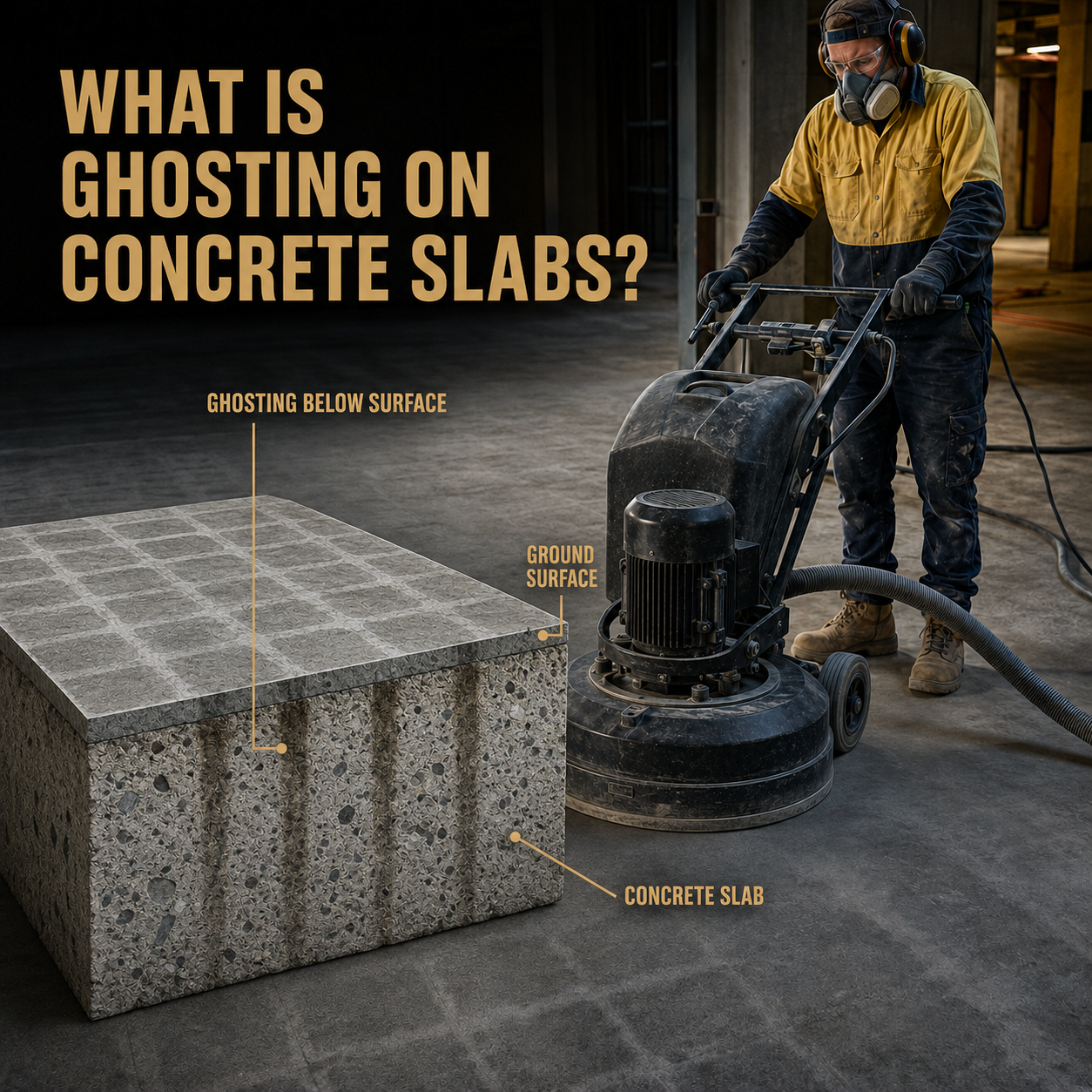
Ghosting is the appearance of faint lines, grids, patches or shadow-like patterns on a concrete slab. These marks often become more noticeable after the floor has been ground, polished, stained or sealed.
In many cases, the pattern reveals what previously covered the concrete—such as tiles, vinyl planks, carpet adhesive, floor mats or construction materials. Ghosting can also result from variations created while the concrete was poured, finished or cured.
The important thing to understand is that ghosting is not always sitting on the surface. It can extend into the concrete, which means additional grinding may reduce the marks without completely removing them.
What Does Concrete Ghosting Look Like?
The appearance depends on what caused it. Common examples include:
- Square grid lines matching an old tile layout
- Straight lines left by vinyl planks or flooring joints
- Dark areas where carpet adhesive was applied
- Shapes from curing blankets, plastic sheeting or materials stored on the slab
- Differences in colour between separate concrete pours
- Lines that appear to follow reinforcing steel
- Uneven patches that become visible after polishing
- Footprints, trowel marks or other patterns left during construction
Ghosting may be difficult to see on an untreated slab. It often becomes clearer as grinding opens the surface or as polishing increases the floor’s reflectivity.
What Causes Ghosting on Concrete Slabs?
Previous Floor Coverings
Old tiles, vinyl, carpet and timber flooring can affect the concrete underneath them. Adhesive may penetrate the slab’s pores, while flooring joints can allow moisture to move or escape differently.
After the covering is removed, its pattern may remain within the concrete. A tiled floor, for example, can leave a visible grid corresponding with the old tiles and grout lines.
Adhesive and Chemical Contamination
Carpet glue, tile adhesive, oils, cleaning chemicals and other contaminants can soak into concrete.
Grinding can remove material that remains on the surface, but it may not remove contamination that has penetrated deeper into the slab. These areas can also react differently when densifier, dye or sealer is applied.
Uneven Moisture Movement
Concrete is porous, so moisture can move through it and carry minerals towards the surface. Floor coverings and their joints may influence where that moisture escapes.
This can create permanent differences in colour or porosity. These differences may only become obvious during the later stages of polishing.
Differences in Curing
Anything that changes how quickly moisture leaves the slab can affect its appearance. Plastic sheeting, curing blankets, stacked materials and uneven curing-compound application may leave light or dark patterns.
The concrete can still be sound, but the affected areas may polish or absorb treatments differently.
Variations Within the Concrete
Concrete is not a manufactured sheet product. Variations in the mix, water-to-cement ratio, aggregate distribution, placement and finishing can all affect its final appearance.
Separate concrete loads or pours may also produce noticeably different colours and hardness levels.
Reinforcement Shadowing
In some circumstances, the position of reinforcing steel can appear as darker lines on a concrete surface. This is sometimes called reinforcement shadowing or ghosting.
It can result from localised changes in the concrete matrix caused by aggregate segregation, movement of the reinforcement, vibration or differences in the paste surrounding the steel. These variations cure differently and create contrasting tones. The Concrete Society describes reinforcement shadowing as an appearance-related change associated with variations in the concrete matrix.
Is Ghosting a Structural Problem?
Usually, ghosting is cosmetic and does not affect the performance of a mechanically polished concrete floor. Bartell Global similarly identifies typical flooring-related ghosting as a cosmetic rather than performance issue.
However, visible lines should not automatically be dismissed as ghosting. Cracks, moisture problems, corrosion staining or slab movement can sometimes create similar-looking marks.
Further investigation may be required if the pattern is accompanied by:
- Active or widening cracks
- Rust-coloured staining
- Damp areas or recurring moisture
- Efflorescence or white salt deposits
- Hollow or drummy sections
- Lifting, curling or movement
- Surface deterioration or spalling
If there is any doubt about the slab’s condition, it should be assessed before grinding, coating or polishing begins.
Can Ghosting Be Removed by Grinding?
Sometimes—but there is no guarantee.
Grinding can remove surface adhesive, coatings, contaminants and shallow staining. It may also reduce ghosting by exposing more aggregate and creating a busier, more blended finish.
However, deeper grinding is not automatically the answer. If the cause extends well into the slab, removing more concrete may simply expose the same pattern at a lower level. It can also create unwanted aggregate exposure, increase project costs and make the floor more difficult to keep visually consistent.
The unspoken truth is that no contractor can accurately promise a completely uniform polished finish without first opening the slab. The finished appearance is controlled partly by the concrete and its history—not only by the grinding equipment or the operator.
How Should Ghosting Be Treated?
The correct approach depends on the cause, depth and required finish.
1. Inspect the Floor
Identify previous floor coverings, adhesive patterns, repairs, stains, separate pours and moisture-prone areas before starting.
2. Remove Surface Contamination
Coatings and heavy adhesive should be removed with suitable diamond tooling. Trying to polish through contamination can clog the tooling, create uneven cutting and interfere with densifier or sealer penetration.
3. Complete a Test Grind
A representative test area is the most reliable way to see what the slab will reveal. Ideally, the sample should be taken through the planned grinding, honing and polishing stages—not stopped after the initial coarse cut.
Some ghosting becomes more visible as the floor reaches the higher polishing grits.
4. Set the Aggregate Exposure
A light grind retains more of the original surface and may leave ghosting clearly visible. A deeper grind can reduce some marks by exposing more aggregate, but it still cannot guarantee their complete removal.
5. Consider the Finish
A satin or lower-sheen finish may make variations less noticeable than a highly reflective polish. Dyes can sometimes help blend colour differences, but the result should be tested because unevenly porous areas may absorb colour differently.
6. Use an Overlay When Uniformity Is Essential
If the customer expects a highly consistent floor with no visible history, a polishable overlay, decorative coating or new floor covering may be more appropriate than polishing the existing slab.
Can Ghosting Be Prevented?
Ghosting is difficult to prevent on an existing slab because much of the damage or variation may have occurred years earlier.
On new slabs intended for exposed or polished concrete, the risk can be reduced by:
- Using a consistent concrete mix and placement method
- Controlling water addition
- Applying curing products evenly
- Avoiding wrinkled plastic or curing materials
- Preventing oils, adhesives and chemicals from contaminating the floor
- Protecting the slab with suitable breathable materials
- Avoiding long-term storage of materials directly on the concrete
- Planning the slab specifically for its final polished finish
Final Thoughts
Ghosting is the concrete slab revealing its history. Old tiles, adhesives, moisture movement, curing differences and placement variations can all leave patterns that become visible after grinding or polishing.
Proper surface preparation and professional diamond tooling can significantly improve the result, but grinding should never be presented as a guaranteed cure. Inspecting the slab, completing a full test area and setting realistic expectations are the best ways to avoid expensive surprises.
For professional concrete grinding, coating removal and polishing equipment, explore the range available from Diamond Tool Warehouse.
Suggested meta description:
Learn what causes ghosting on concrete slabs, whether grinding can remove it, and how to manage ghost lines before polishing or sealing concrete.
Suggested URL slug:what-is-ghosting-on-concrete-slabs