












If you’re looking at concrete grinders and trying to decide between a single disc and a planetary head machine, you’re not alone. It’s one of the most common questions we get from contractors, hire companies and DIYers who are about to spend real money on equipment and want to get it right the first time.
The short answer: it depends on what you’re grinding, how often, and how big the job is. Here’s how to work it out properly.
What’s the Difference?
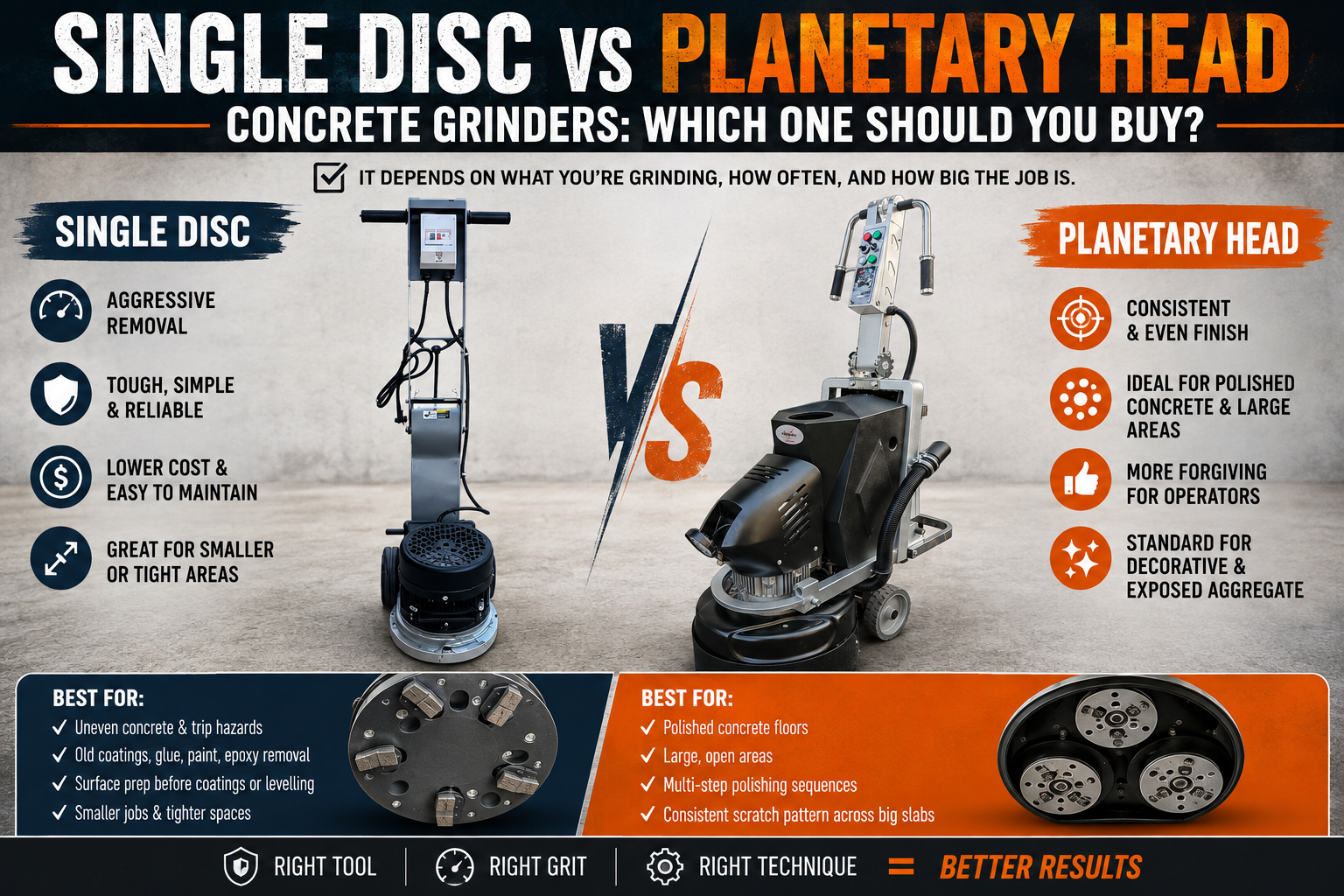
A single disc grinder has one rotating head with tooling (grinding shoes, cup wheels or PCD segments) attached directly to it. It’s simple, tough, and gets diamonds in full contact with the floor — which makes it very good at aggressive, uneven removal work. Most single disc machines run one large plate, typically anywhere from 250mm up to 500mm+ on bigger walk-behind units, spinning at a fixed or variable RPM depending on the model.
A planetary head grinder has multiple smaller heads (usually 3) that spin on their own axis while also rotating around a central point — like planets orbiting a sun. Each head carries its own set of tooling, so you’re running 6, 9 or more individual segments or shoes at once instead of one continuous plate. This dual-rotation motion is what gives planetary machines their more even scratch pattern and smoother finish, and it’s the standard setup for most modern polishing work.
How the Head Design Actually Affects the Job
The mechanical difference matters more than it sounds. On a single disc machine, the whole plate carries the same downward pressure and moves in one direction across the floor, so any high spot, low spot or angle you hold the machine at translates directly into the finish. It’s a more “manual” tool — a lot of the result depends on operator technique, walking speed and pressure.
On a planetary machine, the independent head rotation means each satellite head is constantly self-levelling against the floor as it moves, which is why planetary grinders are so much more forgiving for less experienced operators and why they produce a flatter, more consistent scratch pattern across large areas without as much reliance on technique.
Single Disc: Where It Wins
Single disc machines are built for aggressive removal. If you’re dealing with:
- Uneven concrete, high spots, or trip hazards
- Old coatings, glue, paint, epoxy or mastic that needs to come off fast
- Rough surface prep before a levelling compound or new coating goes down
- Smaller or tighter areas where a compact machine is easier to manoeuvre
…a single disc grinder is usually the better tool. The full-contact head puts more downward pressure through fewer diamonds, which means faster stock removal, especially with PCD shoes on stubborn coatings. They’re also generally cheaper to buy and simpler to maintain — fewer moving parts, fewer things to go wrong on site.
The trade-off is finish quality. Single disc machines tend to leave more visible scratch patterns and can be harder to keep flat over a large area, since you’re relying more on operator technique to avoid dishing or uneven wear.
Tooling compatibility: Single disc machines are usually set up for slide-on/Redi Lock grinding shoes, bolt-on cup wheels, or PCD segments, depending on the adaptor plate fitted. This makes them versatile — you can go from an aggressive #16 or #25 grit metal shoe for coating removal down to a finer grit for a rougher polish, all on the same machine, just by swapping shoes.
Power and weight: Single disc grinders are generally lighter and easier to transport, and a lot of the compact models can run on standard single-phase power, which matters if you’re working in a residential garage or a site without three-phase available. Bigger walk-behind single disc units will usually need three-phase, similar to planetary machines of the same size.
Running cost: Because the full plate is doing the work, tooling wear tends to be more even across the shoes, but you’re also wearing a full set of shoes/segments at once rather than a smaller number of satellite discs, so consumable costs can add up depending on how aggressive the job is.
Planetary Head: Where It Wins
Planetary machines are built for consistency and finish. If your job involves:
- Polished concrete floors, especially multi-step polishing sequences
- Large, open areas where floor flatness matters
- Grinding through multiple grit stages without swapping machines
- Producing a consistent, even scratch pattern across a big slab
…a planetary head grinder is the better investment. Because each head is also spinning independently, the machine self-corrects for minor pressure variations, which makes it far more forgiving for operators still building experience. It’s also the standard choice for exposed aggregate and decorative polishing work, where an even finish is the whole point.
The trade-off is cost and complexity. Planetary machines are more expensive up front, heavier, and have more components (bearings, gearboxes, satellite heads) that need servicing over time.
Tooling compatibility: Planetary machines typically run on the same slide-on/Redi Lock or bolt-on systems as single disc machines, but across multiple heads at once, meaning you need a matching set of shoes or cup wheels for every satellite head rather than just one plate. This is worth factoring into your tooling budget — replacing tooling on a 3-head planetary machine means buying in sets of 3, 6 or 9 depending on segments per head.
Power requirements: Most planetary grinders, especially anything mid-size or larger, will need three-phase power. This is worth checking before you buy if you’re planning to use the machine on residential sites that may only have single-phase available — you may need a generator or transformer, which adds cost and complexity to smaller jobs.
Weight and transport: Planetary machines are noticeably heavier than comparable single disc units due to the extra gearing and satellite heads. This isn’t usually an issue on commercial jobs with vehicle access, but it’s worth considering if you’re regularly working in spaces with stairs, tight doorways or limited loading access.
Dust extraction: Planetary heads generally seal to the floor more consistently than single disc machines, which usually means better dust extraction performance when paired with an H-Class extractor — an important factor if you’re grinding silica-containing materials and need to stay within exposure limits.
Quick Decision Guide
| Job Type | Better Choice |
|---|---|
| Coating, glue or epoxy removal | Single Disc (ideally with PCD shoes) |
| Uneven floors or high-spot grinding | Single Disc |
| Polished concrete floors | Planetary Head |
| Large commercial floor areas | Planetary Head |
| Small residential jobs, garages, patios | Single Disc |
| Multi-stage polishing (metal to resin bond) | Planetary Head |
| Tight budget, occasional use | Single Disc |
| Daily production work, consistent finish required | Planetary Head |
Maintenance Considerations
Neither machine is “set and forget,” but the maintenance profile is different:
Single disc grinders are mechanically simple — one motor, one head, one set of bearings. Day-to-day maintenance is mostly about checking the plate for wear, keeping the adaptor free of dust build-up, and replacing shoes or segments as they wear down. There’s less that can go wrong, and repairs (when needed) are usually quicker and cheaper.
Planetary grinders have more moving parts: a central gearbox plus individual bearings and drive components for each satellite head. Regular checks should include the gearbox oil (if applicable), satellite head bearings for play or noise, and even wear across all heads — uneven wear on one head compared to the others is often the first sign of a bearing issue. Servicing intervals and gearbox oil changes should follow the manufacturer’s schedule, and it’s worth budgeting for professional servicing rather than doing it all in-house, especially in the first year while you learn the machine’s quirks.
Common Mistakes When Choosing Between the Two
- Buying a planetary machine for occasional coating removal. They can do it, but you’ll wear through tooling faster and pay more for a capability you don’t need often. A single disc with PCD shoes will usually do the job faster and cheaper for occasional strip-outs.
- Buying a single disc machine expecting a polished finish. You can get a reasonable result with a skilled operator, but it will take longer and be harder to keep consistent across a large floor than a planetary machine.
- Not checking power supply before buying. Turning up to a residential job with a three-phase-only planetary machine and no generator is a common and avoidable hold-up.
- Underestimating tooling costs on planetary machines. Budgeting for one set of shoes instead of a full matching set across all heads is a common quoting mistake for contractors switching from single disc to planetary for the first time.
The Real Answer for a Lot of Contractors
Most flooring businesses that do a mix of work end up needing both eventually — a single disc machine for aggressive prep and coating removal, and a planetary machine for the polishing side. If you’re just starting out, buy for the work you’re doing right now, not the work you might do in two years. It’s easier to add a second machine once the jobs justify it than to sink money into a planetary head you don’t need yet.
If you’re not sure which setup suits your next job, give us a call — with over 15 years in floor preparation, we can help you match the right grinder, tooling and dust extraction to the actual job in front of you, not just the spec sheet.