











Concrete Densifier: What It Does and When to Apply It
Concrete densifier is an important part of many polished-concrete and floor-hardening systems, but it is often confused with concrete sealer.
A densifier penetrates the surface and reacts within the concrete. A sealer forms a protective barrier that helps resist liquids and staining. They perform different jobs, and in some flooring systems both products may be required.
This guide explains what concrete densifier does, when to apply it and how to avoid common application mistakes.
What Is a Concrete Densifier?
Concrete densifier is a liquid chemical treatment designed to penetrate concrete and react with available calcium compounds inside the slab.
Most densifiers are based on sodium, potassium or lithium silicate. When applied correctly, the silicate reacts within the concrete and helps form additional cementitious material inside its pores.
This process can help:
- Harden the concrete surface
- Reduce surface dusting
- Improve abrasion resistance
- Reduce concrete porosity
- Strengthen weak surface paste
- Support the concrete polishing process
- Improve the floor’s ability to develop a polished finish
Concrete densifier does not create a thick coating on top of the floor. It works within the concrete itself.
What Does Concrete Densifier Actually Do?
Concrete naturally contains microscopic pores and unreacted compounds. A silicate densifier penetrates these pores and reacts with available calcium hydroxide to form additional calcium silicate hydrate, commonly called C-S-H.
C-S-H is the same type of cementitious material that gives cured concrete much of its strength. Creating more of it near the surface helps make the concrete denser, harder and less prone to dusting.
The result is not normally dramatic immediately after application. The main benefits develop as the chemical reaction takes place and the floor continues through the polishing process.
Sodium, Potassium and Lithium Densifiers
Diamond Tool Warehouse supplies the Conpell DuraShield range of concrete densifiers and surface hardeners, with sodium, potassium and lithium formulations available in multiple container sizes. View DuraShield densifiers and surface hardeners
Sodium-silicate densifier
Sodium silicate is a traditional and economical option used for hardening and dust-proofing concrete.
It can be suitable for:
- Large commercial areas
- Warehouses
- Industrial floors
- General concrete hardening
- Projects where product cost is a major consideration
Careful application and removal of excess material are important because overapplication can leave residue on the floor.
Potassium-silicate densifier
Potassium silicate is another penetrating densifier used to improve surface hardness and reduce dusting.
It can offer good penetration and is often used for:
- Commercial concrete floors
- Polished-concrete projects
- Surface hardening
- Concrete floors requiring improved abrasion resistance
Lithium-silicate densifier
Lithium silicate contains smaller particles and is widely used in polished-concrete systems.
It is commonly selected for:
- Mechanically polished concrete
- Floors requiring good penetration
- Projects where reducing surface residue is important
- Later-stage concrete refinement systems
No single chemistry is automatically best for every floor. The condition and porosity of the concrete, the polishing system and the manufacturer’s instructions should determine which product is used.
When Should Concrete Densifier Be Applied?
The correct application point depends on the floor and the polishing system.
In many polished-concrete systems, densifier is applied after the initial coarse grinding stages have opened the concrete but before the final polishing stages begin.
A typical process may include:
- Coarse metal-bond grinding
- Repairs and grouting where required
- Intermediate grinding or honing
- Thorough cleaning
- Application of concrete densifier
- Adequate reaction and drying time
- Continued honing and polishing
- Application of a stain protector or sealer, if required
- Final burnishing
Some contractors apply densifier after approximately the 80, 100 or 200-grit stage. However, this is not a universal rule. The correct stage depends on the tooling system, concrete condition and selected densifier.
Applying it too early may result in some treated material being removed during later aggressive grinding. Applying it too late may reduce penetration because the surface has already become highly refined.
Always follow the product technical data sheet and the requirements of the complete polishing system.
Can Densifier Fix Soft Concrete?
Densifier can considerably improve a soft, porous or dusty concrete surface, but it has limits.
On suitable concrete, densifier can:
- Harden weak surface paste
- Reduce dusting
- Improve abrasion resistance
- Reduce rapid wear during polishing
- Help the floor accept later polishing stages
- Improve the clarity and durability of the final finish
A highly porous floor may absorb densifier quickly and require more product than dense concrete. Additional applications may sometimes be needed, provided the manufacturer permits them.
However, densifier cannot repair every weak slab. It will not fix:
- Structurally defective concrete
- Deep delamination
- Severe rain damage extending below the surface
- Contaminated or crumbling concrete
- Major cracking or slab movement
- A failed topping or poorly bonded overlay
If the surface can be easily scraped away or continues to break down after grinding, the problem may require deeper removal, repair or replacement—not simply more densifier.
Concrete Densifier vs Concrete Sealer
Although the terms are sometimes used interchangeably, densifier and sealer are not the same product.
| Concrete densifier | Concrete sealer |
|---|---|
| Penetrates and chemically reacts within concrete | Creates a protective treatment at or near the surface |
| Helps harden and strengthen the surface | Helps protect against water, oil and staining |
| Reduces dusting and improves abrasion resistance | Reduces liquid penetration |
| Commonly used during concrete polishing | Usually applied near the end of the system |
| Does not normally create a thick film | May be penetrating or film-forming |
| Does not make concrete completely stain-proof | Provides additional stain and chemical resistance, depending on the product |
A densified floor is not automatically sealed. Even after densification and polishing, concrete may still absorb oil, food, chemicals or coloured liquids.
For commercial, residential or food-service floors, a compatible penetrating guard, stain protector or sealer may still be required.
How Much Concrete Densifier Do You Need?
There is no reliable universal application rate for every concrete floor.
Coverage depends on:
- Concrete porosity
- Surface hardness
- Age and condition of the slab
- How aggressively the floor has been ground
- Product chemistry and concentration
- Application method
- Temperature and environmental conditions
- Whether the floor has previously been treated
Soft or highly porous concrete normally absorbs more densifier than dense, well-finished concrete.
As a general working principle, apply enough material to keep the surface evenly wet for the reaction period specified by the manufacturer. Do not assume that applying more product will produce a harder floor.
Overapplication wastes material and can leave difficult residue. Always calculate the quantity using the coverage rate stated on the selected product’s technical data sheet, then test it on a small representative area.
How to Apply Concrete Densifier
The exact method varies by product, but a typical application process includes the following steps.
1. Prepare the concrete
The floor must be:
- Clean
- Free from dust
- Free from oil and contamination
- Mechanically opened to the correct stage
- Free from incompatible coatings or sealers
Vacuum the floor thoroughly before applying densifier. Dust left on the surface can mix with the liquid and interfere with penetration.
2. Test a small area
Test the product in an inconspicuous section to assess:
- Absorption rate
- Reaction time
- Surface appearance
- Product coverage
- Potential residue
This is particularly important on coloured, decorative or previously treated concrete.
3. Apply an even coat
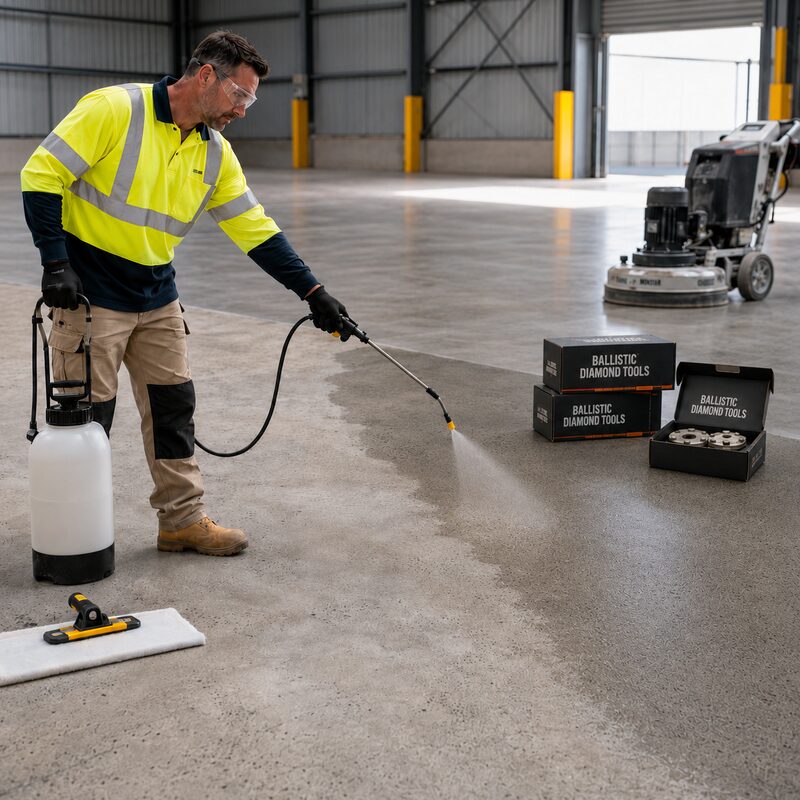
Apply the densifier evenly using the method recommended by the manufacturer. Depending on the product, this may involve a low-pressure sprayer, microfibre applicator, broom or automatic scrubber.
Avoid allowing the product to collect in low areas.
4. Keep the surface evenly wet
Allow the densifier to remain wet for the specified reaction period. Redistribute material from wet areas to sections absorbing it more quickly.
Do not allow isolated patches to dry prematurely.
5. Remove all excess product
Once the concrete stops absorbing material—or once the required reaction time is complete—remove any unabsorbed densifier as directed by the manufacturer.
This may involve:
- Redistributing excess material
- Scrubbing the surface
- Removing it with a wet vacuum or scrubber
- Rinsing with clean water when required
- Dry buffing, depending on the specified system
Never assume excess densifier can simply dry on the floor.
Why Excess Densifier Must Be Removed
One of the most common application mistakes is allowing unabsorbed densifier to dry on the concrete.
This can leave:
- White residue
- Hazy patches
- Sticky areas
- Uneven colour
- Hardened deposits
- Marks that become difficult to remove
- Problems during later polishing stages
More densifier does not necessarily mean better performance. Once the floor has absorbed what it can accept, the remaining liquid must be managed correctly.
If residue forms, it may require mechanical scrubbing, water, cleaning chemicals or additional grinding to remove. Follow the manufacturer’s instructions rather than experimenting with strong acids or incompatible cleaners.
Densifier’s Role in Polished Concrete
Densifier is important in polished-concrete systems because polishing progressively refines the concrete surface. If the surface paste is too soft, it can continue to break down instead of developing a clean, consistent polish.
A correctly densified floor can provide:
- A harder surface for polishing
- Improved abrasion resistance
- Reduced dust generation
- Better polishing-pad performance
- Improved clarity and light reflection
- A more durable finished floor
- Reduced maintenance compared with untreated dusty concrete
Densifier does not create shine by itself. The shine is developed through the mechanical refinement of the concrete using progressively finer diamond tooling.
A floor that has only been densified but not properly polished should not be expected to have the appearance of mechanically polished concrete.
Common Densifier Application Mistakes
Avoid these frequent problems:
- Applying densifier over dust or contamination
- Using densifier over an existing sealer
- Applying it before the concrete has been sufficiently opened
- Applying it so late that penetration is limited
- Allowing puddles to form
- Letting excess product dry on the surface
- Assuming every floor has the same coverage rate
- Applying repeated coats without checking manufacturer instructions
- Expecting densifier to repair structurally failed concrete
- Assuming a densified floor is automatically stain-proof
- Continuing to polish before the product is ready
Choosing the Right Densifier
Before purchasing a concrete densifier, consider:
- Whether the floor will be mechanically polished
- The hardness and porosity of the concrete
- Whether the floor is dusty or rain-damaged
- The required abrasion resistance
- Whether a sealer or stain protector will be applied later
- The total floor area
- The specified polishing system
- Whether sodium, potassium or lithium silicate is preferred
Diamond Tool Warehouse supplies Conpell DuraShield Sodium, Potassium and Lithium densifiers in several container sizes, allowing contractors to select a suitable option for smaller projects or large commercial floors.
Get Concrete Densifier from Diamond Tool Warehouse
Diamond Tool Warehouse supplies concrete densifiers, surface hardeners, grinding equipment and diamond polishing tooling to contractors across Australia.
If you are unsure which densifier to use, contact our team with:
- The total floor area
- The condition of the concrete
- Your current grinding stage
- The intended final finish
- Whether the floor will be sealed
- The equipment and polishing system being used
We can help you select the appropriate densifier and calculate the product quantity required for the project.
View DuraShield densifiers and surface hardeners at Diamond Tool Warehouse