











Why You Need an H-Class Vacuum and Air Scrubber for Concrete Grinding
Concrete grinding, cutting and surface preparation can release large quantities of extremely fine concrete dust into the workplace. While visible dust is an obvious problem, the particles presenting the greatest health risk may be too small to see.
Concrete, mortar, bricks, tiles and many masonry products contain crystalline silica. When these materials are ground, cut or mechanically prepared, they can release respirable crystalline silica dust.
These microscopic particles can travel deep into the lungs and may contribute to serious and irreversible illnesses, including silicosis, lung cancer and chronic obstructive pulmonary disease.
Effective concrete grinding dust control requires more than placing a standard vacuum near the grinder.
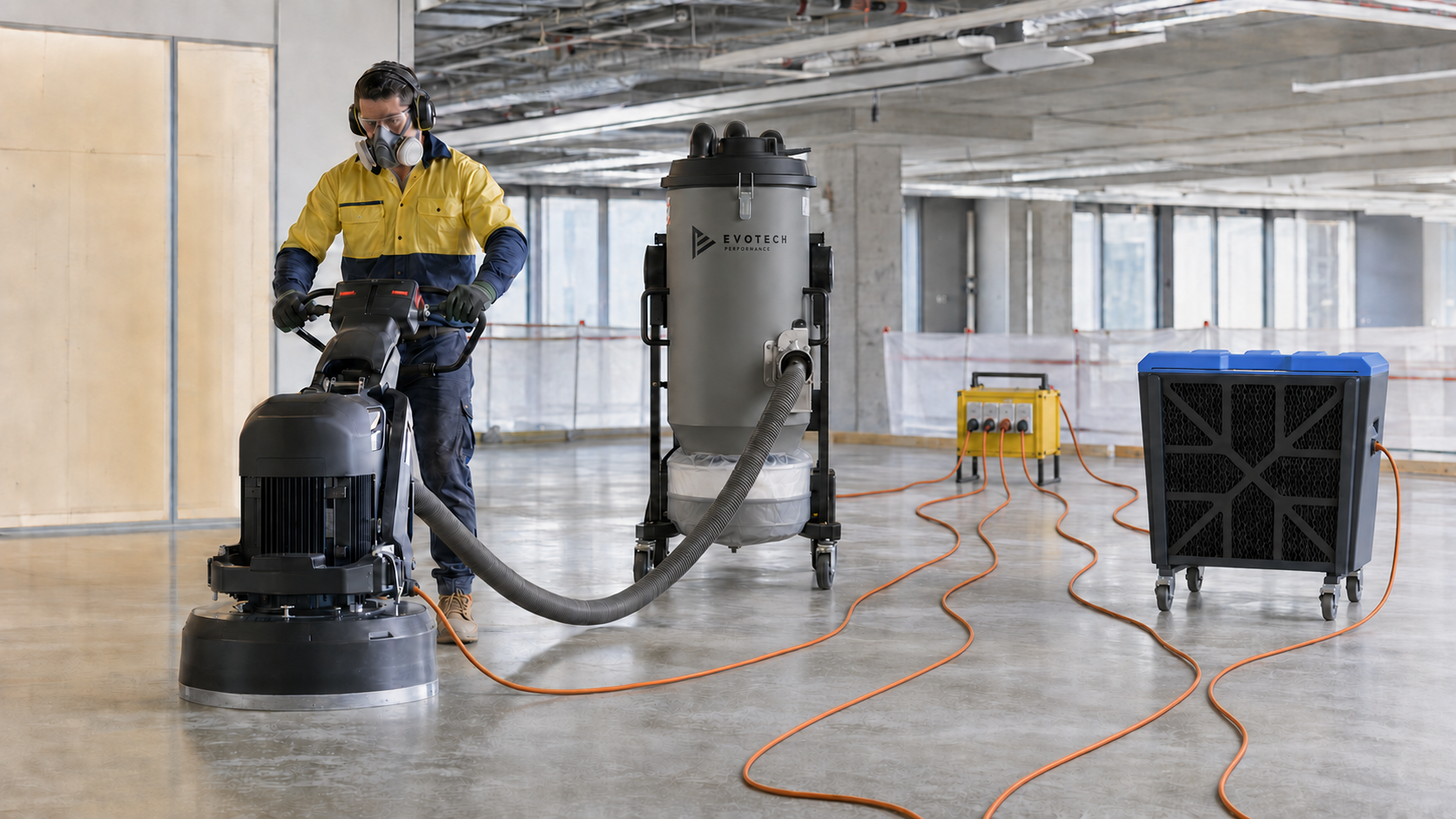
Every dry concrete grinding job should use a properly matched H-Class dust extractor connected directly to the grinder. When grinding indoors or inside an enclosed area, an appropriately sized air scrubber should also be used to filter fine particles that escape into the surrounding air.
These machines perform two different but complementary jobs:
- The H-Class dust extractor captures concrete dust at the grinder.
- The air scrubber filters airborne particles throughout the work area.
The H-Class dust extractor controls dust at its source. The air scrubber helps control escaped dust throughout the room.
For safer indoor concrete grinding, you need both.
What Is an H-Class Dust Extractor?
An H-Class dust extractor—often called an H-Class vacuum—is an industrial dust-collection machine designed to capture and contain hazardous dust.
During dry concrete grinding, the extractor connects directly to the concrete grinder through an appropriate extraction hose.
As the grinding machine removes material, the extractor creates airflow through the grinder’s dust shroud. This pulls dust away from the grinding head and transports it into the extractor before it can spread throughout the room.
This process may be referred to as:
- On-tool dust extraction
- Source capture
- Local exhaust ventilation
- Grinder dust extraction
- Concrete dust extraction
Capturing dust at the grinding head is the most important part of a dry concrete grinding dust-control system.
A properly matched H-Class dust extractor can help:
- Capture concrete dust as it is generated
- Reduce dust entering the operator’s breathing zone
- Prevent dust from spreading across the job site
- Improve visibility around the grinder
- Reduce contamination of walls and equipment
- Make final cleaning faster and easier
- Filter and contain hazardous fine dust
- Reduce dust exposure during normal grinding operations
- Safely contain collected material when used with the correct bagging system
An H-Class Vacuum Should Be Used Every Time
Diamond Tool Warehouse recommends using a properly matched H-Class dust extractor every time concrete is ground using dry methods.
A standard workshop or domestic vacuum is not suitable for collecting hazardous concrete dust. Even a domestic vacuum advertised as having a HEPA filter may not have the construction, sealing, airflow, filtration classification or disposal system required for professional silica dust extraction.
Using an H-Class extractor every time provides a clear and consistent safety standard. It also removes uncertainty about whether a lower-class machine is appropriate for a particular grinder or project.
However, an H-Class rating alone does not guarantee effective dust control.
The extractor must also:
- Provide sufficient airflow for the concrete grinder
- Be connected to a correctly fitted dust shroud
- Use suitable, undamaged extraction hoses
- Have clean and properly installed filters
- Include a suitable dust-containment system
- Be operated according to the manufacturer’s instructions
- Be inspected and maintained regularly
An undersized, blocked or poorly maintained H-Class extractor may not capture dust effectively.
H-Class extraction should be the minimum starting point for dry concrete grinding—not an optional upgrade.
What Is an Air Scrubber?
An air scrubber is a portable air-filtration machine designed to remove fine airborne particles from the surrounding environment.
The machine draws contaminated air through a series of filters before returning filtered air to the work area or exhausting it outside a contained zone.
Unlike an H-Class dust extractor, an air scrubber is not normally connected directly to the concrete grinder. It filters the general air inside the room or controlled work zone.
An air scrubber can help:
- Capture fine particles that escape the grinder’s dust shroud
- Reduce airborne concrete dust inside enclosed areas
- Improve visibility during grinding
- Reduce dust spreading into adjoining rooms
- Filter dust disturbed during cleanup
- Support properly designed contained work areas
- Support negative-air arrangements
- Improve general site cleanliness
- Provide additional protection for nearby workers and building occupants
The air scrubber acts as a secondary line of defence. It helps manage dust that was not successfully captured by the grinder’s on-tool extraction system.
H-Class Dust Extractor vs Air Scrubber
An H-Class dust extractor and an air scrubber are not interchangeable.
| Equipment | Primary purpose | How it is used |
|---|---|---|
| H-Class dust extractor | Captures concrete dust at its source | Connected directly to the concrete grinder |
| Air scrubber | Filters escaped airborne particles | Positioned inside or ducted from the work area |
| Complete dust-control system | Controls dust at the grinder and throughout the room | Uses both machines together |
An air scrubber should never be treated as a replacement for an H-Class dust extractor.
Without an extractor connected directly to the grinder, large quantities of concrete dust may enter the work area before the air scrubber has an opportunity to filter it. Workers may already be exposed while the air scrubber attempts to clean contaminated air.
The first priority must always be capturing dust at the grinding head.
Capture concrete dust at its source first. Then filter the surrounding air.
Why Isn’t an H-Class Dust Extractor Enough by Itself?
An H-Class dust extractor is essential for dry concrete grinding, but no extraction system captures every particle.
Concrete dust can escape because of:
- Gaps between the grinder shroud and the floor
- Grinding against walls and edges
- Uneven or damaged concrete
- Cracks and expansion joints
- Worn or incorrectly adjusted dust skirts
- An undersized dust extractor
- Incorrect hose diameter
- Excessive hose length
- Blocked, crushed or kinked hoses
- Dirty or overloaded filters
- Overfilled dust bags
- Poor grinder technique
- Disconnected hoses
- Aggressive coating-removal tooling
- Changing grinding shoes or tooling
- Replacing bags and filters
- Cleaning equipment after grinding
Dust can also be disturbed when workers walk through the area, move hoses or use unsuitable cleaning methods.
Once fine concrete dust becomes airborne, it may remain suspended and travel beyond the immediate grinding zone. An air scrubber helps filter this escaped material before it settles throughout the building or moves into occupied areas.
Why Isn’t an Air Scrubber Enough by Itself?
An air scrubber filters dust after it has escaped into the surrounding air. It does not provide direct dust extraction at the grinder.
Operating a concrete grinder without on-tool extraction can release a large amount of dust directly into the operator’s breathing zone.
An air scrubber may eventually filter some of that airborne dust, but it cannot prevent the initial release. It should therefore be used as an additional control—not as a substitute for H-Class extraction.
For dry concrete grinding:
- Connect a properly matched H-Class dust extractor to the grinder.
- Capture as much dust as possible at the grinding head.
- Use an air scrubber to filter escaped airborne particles.
- Apply suitable isolation, cleaning and respiratory protection measures.
Five Reasons You Need Both for Indoor Concrete Grinding
1. Dust is captured directly from the grinder
The H-Class dust extractor pulls dust through the grinder’s shroud before it spreads throughout the work area.
2. Escaped particles are filtered from the room
The air scrubber continuously filters airborne particles that bypass the dust shroud or escape during edge grinding, tooling changes and cleanup.
3. The entire work area receives better protection
On-tool extraction primarily controls dust immediately around the grinder. Air filtration helps manage contamination throughout the wider room.
4. Dust is less likely to spread
Airborne concrete dust can move through doorways, corridors, ventilation systems and gaps in temporary barriers. Correct air scrubber placement can help reduce this movement.
5. Nearby workers receive additional protection
The grinder operator is not the only person who may be exposed. Other trades, cleaners, clients and building occupants may encounter dust that travels beyond the grinding area.
Using an H-Class dust extractor and air scrubber together creates a more complete concrete dust-control system.
Recommended Indoor Concrete Grinding Setup
A safer indoor concrete grinding setup should include:
- Concrete grinder with a correctly adjusted dust shroud
- Properly matched H-Class dust extractor
- Suitable anti-static or heavy-duty extraction hose
- Effective filter-cleaning system
- Clean and correctly installed filters
- Sealed or continuous-bag dust-disposal system
- Appropriately sized air scrubber
- Isolation barriers around the work area
- Suitable respiratory protective equipment where required
- Silica risk assessment
- Site-specific safe work method statement
- Appropriate cleaning and waste-disposal procedures
Simply owning an H-Class dust extractor does not automatically create a safe grinding system. The equipment must provide sufficient airflow, be correctly connected and remain properly maintained throughout the job.
How to Match an H-Class Extractor to a Concrete Grinder
One of the most common mistakes is selecting an extractor based only on motor wattage.
The extractor must provide enough airflow and suction for the grinder, tooling and work being performed.
Consider:
- Grinder size
- Grinder motor power
- Grinding width
- Number of grinding heads
- Manufacturer airflow requirements
- Concrete hardness
- Tooling type
- Material-removal rate
- Hose diameter
- Hose length
- Filter surface area
- Filter-cleaning system
- Dust-storage capacity
- Available power supply
A small hand grinder and a large planetary concrete grinder do not create the same volume of dust.
Aggressive PCD tooling, coarse diamond segments and coating-removal tools can remove material quickly and create a heavy dust load. Large planetary floor grinders generally require considerably more extraction capacity than compact single-head machines.
If the extractor cannot maintain adequate airflow, dust may begin escaping around the grinder’s shroud.
Why Hose Diameter and Length Matter
The hose connecting the concrete grinder to the H-Class dust extractor is an important part of the extraction system.
Using an excessively long, narrow or damaged hose can restrict airflow and reduce dust capture.
To maintain performance:
- Use the hose diameter recommended by the equipment manufacturer
- Keep the hose as short as reasonably practical
- Avoid tight bends and kinks
- Inspect hoses for holes and split connections
- Keep the inside of the hose clear
- Secure every connection
- Use suitable anti-static equipment where required
A powerful dust extractor cannot perform properly if airflow is restricted before the dust reaches the machine.
How to Position an Air Scrubber
Correct air scrubber placement is essential.
Position the air scrubber where it can draw contaminated air away from the operator without blowing dust across the room.
Avoid directing its clean-air outlet where it could:
- Blow directly over the grinding area
- Disturb settled concrete dust
- Push contaminated air towards workers
- Spread dust into adjoining rooms
- Interfere with the grinder’s dust shroud
- Create unwanted turbulence around containment barriers
Where possible, create airflow that moves contaminated air away from workers and towards the air scrubber’s intake.
On contained projects, an air scrubber may also form part of a negative-air system.
Using an Air Scrubber for Negative Air
A negative-air arrangement generally involves exhausting filtered air outside the contained work zone. This helps encourage air to flow into the controlled area instead of allowing contaminated air to escape.
A negative-air system can help reduce dust movement into:
- Adjoining rooms
- Hallways
- Occupied spaces
- Air-conditioning systems
- Other contractors’ work areas
- Public areas
Negative-air systems require proper planning. Machine capacity, room size, duct length, filtration, make-up air and the required number of air changes must all be considered.
Simply placing an air scrubber in a room does not automatically create effective negative pressure.
How to Calculate Air Changes per Hour
When selecting an air scrubber for concrete dust, consider the machine’s rated airflow and the volume of the work area.
Air changes per hour indicate how often the machine can theoretically process the room’s air volume.
Use this calculation:
Air changes per hour = air scrubber airflow per hour ÷ room volume
For example, a room measuring 10 metres long, 8 metres wide and 3 metres high has a volume of:
10 × 8 × 3 = 240 cubic metres
An air scrubber rated at 1,200 cubic metres per hour would theoretically provide:
1,200 ÷ 240 = 5 air changes per hour
This is a simplified calculation. Actual performance can be affected by:
- Filter condition
- Ducting
- Room layout
- Open doorways
- Air leakage
- Machine placement
- Dust volume
- Obstructions
- Airflow restrictions
Large or heavily contaminated work areas may require multiple air scrubbers.
Filters and Maintenance Matter
Even a high-quality H-Class dust extractor will lose performance if it is not correctly maintained.
Check the following before and during every grinding job:
- Filters are correctly installed
- Filters are not damaged
- Seals and gaskets are in good condition
- Hoses are clear and undamaged
- Hose connections are secure
- The grinder shroud is correctly adjusted
- Dust bags are not overfilled
- Filter-cleaning systems operate correctly
- Airflow remains adequate
- Warning indicators are not ignored
A clogged filter reduces airflow. When airflow falls, less dust is captured at the grinder—even if the extractor motor still sounds normal.
Always follow the manufacturer’s instructions for filter inspection, cleaning and replacement.
The Benefits of Automatic or Jet-Pulse Filter Cleaning
Concrete dust can quickly accumulate on a dust extractor’s filters. As the filter becomes loaded, airflow and extraction performance may fall.
An automatic or jet-pulse filter-cleaning system helps remove built-up dust from the filter surface so the extractor can maintain more consistent suction.
Effective filter cleaning can:
- Maintain stronger airflow
- Reduce unnecessary downtime
- Improve dust capture
- Extend filter life
- Reduce manual filter handling
- Improve productivity on larger grinding jobs
Filter cleaning does not eliminate the need for inspection and maintenance. Damaged or excessively loaded filters must still be replaced according to the manufacturer’s instructions.
Safely Disposing of Concrete Dust
Concrete dust does not stop being hazardous after it enters the extractor.
Changing bags or handling contaminated filters can release concentrated dust directly into the operator’s breathing zone.
To reduce exposure:
- Never overfill dust bags
- Seal bags before removing them from the controlled area
- Follow the manufacturer’s bag-changing procedure
- Use sealable or continuous-bag systems where appropriate
- Avoid shaking dusty filters
- Wear suitable respiratory protection when required
- Never use compressed air to clean filters or clothing
- Dispose of collected material according to site and local requirements
Continuous-bag systems allow operators to seal individual sections of the bag before removal. This can reduce direct contact with collected dust and minimise dust release during disposal.
Never Dry Sweep Concrete Dust
Dry sweeping can return settled silica-containing dust to the air, creating another exposure risk after grinding has stopped.
Safer cleaning methods can include:
- Vacuuming with an appropriate industrial H-Class vacuum
- Wet cleaning where suitable
- Vacuuming surfaces before removing containment barriers
- Keeping the air scrubber operating during final cleanup
- Cleaning tools before taking them out of the controlled area
Do not use compressed air or a blower to move concrete dust around the work area.
Can You Use a Domestic Vacuum for Concrete Grinding?
No. A domestic vacuum cleaner should not be used to collect hazardous concrete grinding dust.
Even when advertised as having a HEPA filter, a domestic vacuum may not have:
- A certified H-Class filtration system
- Adequate airflow for a concrete grinder
- Properly sealed construction
- Safe filter-cleaning features
- Appropriate dust-containment bags
- Industrial durability
- Suitable hoses and connections
Concrete grinding requires a purpose-built industrial dust extractor that can safely capture, filter and contain fine hazardous dust.
Do You Still Need Respiratory Protection?
Using an H-Class dust extractor and air scrubber does not automatically eliminate the need for respiratory protective equipment.
RPE requirements can depend on:
- The task being performed
- Duration of the work
- Whether grinding occurs indoors or outdoors
- Silica content of the material
- Effectiveness of engineering controls
- Air-monitoring results
- Site conditions
- Applicable legislation and codes of practice
- The project’s risk assessment and SWMS
Where tight-fitting respiratory protection is required, workers must be fit-tested for the specific make and model being worn. Facial hair must not interfere with the respirator’s sealing surface.
PPE is an important part of a dust-control system, but it should not replace effective engineering controls.
Australian Silica Dust Requirements
Australian businesses must manage risks associated with respirable crystalline silica.
The precise controls required depend on the state or territory, material, task and working conditions. Contractors must consult the WHS legislation and codes of practice applying to their location and conduct a job-specific risk assessment.
Regardless of the minimum regulatory requirements for a particular task, Diamond Tool Warehouse recommends using H-Class extraction every time concrete is ground using dry methods.
For indoor and enclosed concrete grinding, an air scrubber provides an important additional level of airborne-dust control. However, it does not replace the H-Class extractor connected directly to the grinder.
Common Concrete Grinding Dust-Control Mistakes
Avoid these common mistakes:
- Grinding concrete without an H-Class dust extractor
- Using an air scrubber instead of on-tool extraction
- Assuming an H-Class label guarantees sufficient airflow
- Connecting a large grinder to an undersized extractor
- Using excessively long or narrow hoses
- Continuing to grind with blocked filters
- Operating with a damaged dust skirt
- Removing the grinder’s shroud to reach edges
- Dry sweeping after grinding
- Cleaning equipment with compressed air
- Emptying loose dust directly into a bin
- Overfilling dust-collection bags
- Turning off the air scrubber immediately after grinding
- Allowing unnecessary workers into the grinding zone
- Relying only on disposable masks
- Ignoring manufacturer maintenance instructions
Effective silica dust control depends on the complete system—not one machine, filter or safety label.
Frequently Asked Questions
Should an H-Class vacuum be used every time concrete is ground?
Yes. Diamond Tool Warehouse recommends using a properly matched H-Class dust extractor every time concrete is ground using dry methods.
The extractor should be connected directly to the grinder through a correctly fitted dust shroud and suitable extraction hose.
Do I need an air scrubber when grinding concrete indoors?
An air scrubber should be used as an additional dust-control measure for indoor and enclosed concrete grinding.
The H-Class extractor captures dust at the grinder, while the air scrubber filters fine particles that escape into the surrounding work area.
Does an air scrubber replace an H-Class vacuum?
No. An air scrubber filters airborne particles inside the work area. It does not capture dust directly from the grinding head.
Always use an H-Class dust extractor for dry concrete grinding. Add an appropriately sized air scrubber for indoor or enclosed work.
Can I use a standard workshop vacuum?
No. Standard workshop and domestic vacuum cleaners are not suitable for hazardous concrete grinding dust.
Use a purpose-built H-Class industrial dust extractor with sufficient airflow for the concrete grinder.
What size H-Class dust extractor do I need?
The correct extractor depends on:
- Grinder size
- Grinding width
- Number of grinding heads
- Tooling
- Material-removal rate
- Hose diameter and length
- Manufacturer airflow requirements
Large planetary grinders generally require considerably more extraction capacity than small hand grinders.
How long should an air scrubber operate after grinding?
The required operating time depends on the room volume, air scrubber capacity, dust levels, containment and number of air changes per hour.
Keeping the air scrubber operating during final cleaning can help capture dust disturbed after grinding has stopped. A site-specific risk assessment should determine when the area can be safely reopened.
Is a HEPA vacuum automatically an H-Class vacuum?
No. A vacuum containing a HEPA filter is not automatically an H-Class dust extractor.
H-Class classification applies to the complete machine and its ability to safely capture and contain hazardous dust—not only the filter material.
Control Dust at the Grinder and Throughout the Room
Every dry concrete grinding job should begin with a properly matched H-Class dust extractor connected directly to the grinder.
For indoor and enclosed projects, an appropriately sized air scrubber should also be used to filter fine particles that escape into the surrounding work area.
- The H-Class dust extractor captures silica-containing dust at the grinding head.
- The air scrubber filters fine airborne particles throughout the room.
- Appropriate isolation, cleaning, maintenance and PPE complete the dust-control system.
One machine controls dust at its source. The other helps control escaped dust throughout the workplace.
Every dry concrete grinding job needs H-Class extraction. Indoor and enclosed grinding jobs should also use an air scrubber for more complete concrete dust control.
Diamond Tool Warehouse supplies professional concrete grinders, H-Class dust extractors, air scrubbers, extraction hoses, diamond grinding tools and safety equipment for demanding floor-preparation projects across Australia.
Need help selecting the right equipment? Contact Diamond Tool Warehouse for assistance matching your concrete grinder with a suitable H-Class dust extractor and air scrubber.
Disclaimer: This article contains general information and does not constitute legal or workplace health and safety advice. Always follow the equipment manufacturer’s instructions, complete a site-specific risk assessment and comply with the WHS legislation and codes of practice applying in your state or territory.