












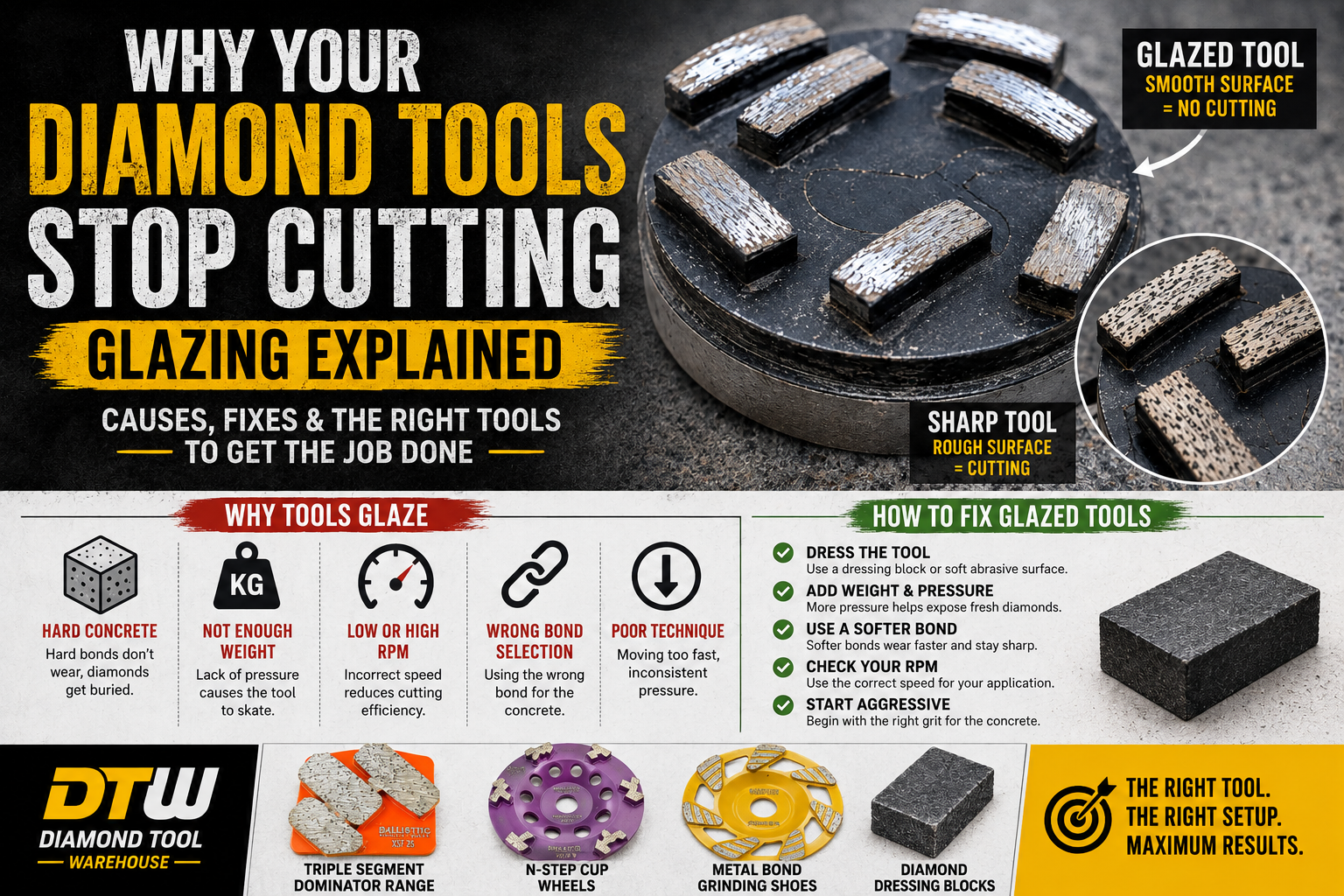
If you’ve ever been grinding concrete and suddenly noticed your diamond tooling has stopped cutting, you’re not alone.
This is one of the most common problems flooring contractors, concrete polishers, and hire companies experience. Many operators assume their diamonds are worn out, poor quality, or defective. However, in most cases, the problem is something completely different.
The real culprit is usually diamond glazing.
Understanding why glazing happens and how to fix it can dramatically increase productivity, improve surface quality, reduce labour costs, and make your tooling last significantly longer.
Let’s look at what actually causes glazing and how you can prevent it.
What Is Diamond Glazing?
Diamond tooling works by exposing fresh industrial diamonds as the tool wears.
Inside every metal bond diamond segment are thousands of industrial diamonds held together by a specially formulated metal bond. As the segment wears away, fresh sharp diamonds are continually exposed.
When everything is working correctly, the tool constantly renews itself.
Glazing happens when this process stops.
Instead of wearing correctly, the metal bond becomes polished smooth. The diamonds either become buried inside the bond or wear flat. Rather than cutting into the concrete, the tooling simply slides across the surface.
Think of it like trying to cut timber with a butter knife.
The machine still runs.
The tooling still spins.
However, very little concrete is actually being removed.
Common signs of glazing include:
- Grinding becomes noticeably slower.
- The machine feels like it is skating across the floor.
- The tooling becomes shiny or mirror-like.
- Little dust is produced.
- The concrete surface barely changes after multiple passes.
- The machine begins generating more heat.
Many operators mistakenly think they need new tooling when the existing diamonds can often be restored.
Why Diamond Tools Glaze
Glazing is rarely caused by poor manufacturing.
Instead, it is usually caused by using the wrong setup for the floor being ground.
The most common causes include:
- The wrong bond hardness.
- Concrete that is harder than expected.
- A machine that is too light.
- Incorrect grinding speed.
- Too little downward pressure.
- Incorrect grinding technique.
Let’s look at each one.
Hard Concrete vs Soft Concrete
The hardness of the concrete has one of the biggest impacts on diamond performance.
Many people think all concrete is the same.
It isn’t.
Concrete hardness can vary enormously depending on:
- Cement type
- Aggregate type
- Age
- Water content
- Finishing methods
- Densifiers
- Environmental conditions
Some industrial warehouse slabs are extremely hard.
Others can be surprisingly soft.
Using the wrong diamond bond on either type creates problems.
Hard Concrete Requires a Soft Bond
This sounds backwards, but it is true.
Hard concrete does not wear the metal bond very quickly.
If you use a hard bond on hard concrete, the bond refuses to wear away.
Eventually, the diamonds become trapped inside the segment.
The surface becomes smooth.
The tooling glazes.
Grinding almost stops.
A softer bond wears faster, continually exposing new diamonds and keeping the tooling cutting aggressively.
Soft Concrete Requires a Hard Bond
Soft concrete rapidly wears the metal bond.
If you use a soft bond on soft concrete, the bond disappears too quickly.
Instead of glazing, the tooling wears out extremely fast.
You may only get a fraction of the expected life.
A harder bond slows this wear and dramatically extends tooling life.
Choosing the Correct Bond Is Critical
Bond selection is far more important than grit selection.
Many contractors automatically choose the same tooling for every job.
Unfortunately, there is no universal diamond.
Professional contractors often carry multiple bond types because every slab behaves differently.
Choosing the correct bond means:
- Faster grinding
- Longer tooling life
- Lower grinding costs
- Better scratch patterns
- Reduced operator fatigue
Machine Weight Makes a Huge Difference
Diamond tools need pressure to cut.
One of the most overlooked causes of glazing is using a machine that simply isn’t heavy enough.
A heavier grinder pushes the diamonds deeper into the concrete.
This allows the metal bond to wear correctly and continually expose fresh cutting diamonds.
Lighter machines often skate across extremely hard concrete.
Instead of cutting, they polish the tooling.
If your machine accepts additional weights, adding weight can often restore cutting performance immediately.
Likewise, if you’re using a small edge grinder or compact planetary grinder on a very hard slab, you may need a more aggressive tool or a heavier machine to achieve the desired results.
RPM Matters More Than Most People Think
Grinding speed is another factor that is often overlooked.
If the RPM is too low:
- Diamonds may not generate enough cutting action.
- Productivity drops.
- Glazing becomes more likely.
If the RPM is too high:
- Excess heat builds up.
- Diamonds can polish instead of fracture.
- Segment temperatures rise.
- Premature glazing can occur.
Every machine has an optimal operating speed.
Running within the manufacturer’s recommended RPM range usually delivers the best balance of cutting speed and tooling life.
Operator Technique Can Also Cause Glazing
Even the best tooling can glaze if it is used incorrectly.
Common mistakes include:
- Moving too quickly across the floor.
- Never overlapping passes.
- Constantly lifting the machine.
- Starting with a grit that is too fine.
- Applying inconsistent pressure.
Allow the diamonds time to bite into the concrete.
Steady, controlled passes almost always outperform rushing across the slab.
How to Fix Glazed Diamond Tools
The good news is that glazed diamonds usually do not need to be thrown away.
In many cases they can be reopened.
Some of the most effective methods include:
Dress the Tool
Grinding a soft abrasive material such as a dressing block or sacrificial concrete can strip away the polished metal bond and expose fresh diamonds.
Many professional contractors keep dressing blocks in the trailer for exactly this reason.
Increase Downward Pressure
Adding machine weights or using a heavier grinder often helps the tooling start cutting again.
More pressure helps expose fresh diamonds.
Switch to a Softer Bond
If you are grinding extremely hard concrete, changing to a softer bond is often the permanent solution.
The correct bond will continually self-sharpen instead of glazing.
Reduce Grinding Speed if Required
Some grinders allow RPM adjustment.
If excessive heat is contributing to glazing, reducing the speed slightly may improve cutting performance.
Always refer to the machine manufacturer’s recommendations before making major speed changes.
Start With a More Aggressive Grit
If the floor is extremely dense, starting with a coarse metal bond such as 16, 20 or 25 grit can help open the surface before progressing through finer grits.
Beginning with tooling that is too fine often causes unnecessary glazing and greatly increases grinding time.
When Should You Replace Diamond Tooling?
Not every tool can be saved.
Replace your tooling when:
- The diamond segment is approaching minimum height.
- Diamonds have been completely consumed.
- Segments are cracked.
- Segments have broken away from the plate.
- The tool can no longer be dressed successfully.
If dressing no longer restores cutting performance, replacement is usually the most economical option.
Continuing to grind with worn tooling wastes time, electricity, and labour.
Recommended Diamond Tool Warehouse Products
At Diamond Tool Warehouse, we stock tooling designed specifically to minimise glazing while maximising production across a wide range of Australian concrete conditions.
Orange 25 Grit Triple Segment Exposed Aggregate Dominator
One of our most popular grinding tools for opening extremely hard exposed aggregate concrete.
The triple-segment design delivers excellent stability, while the aggressive diamond layout removes material quickly and helps reduce glazing on dense slabs.
Ideal for:
- Exposed aggregate preparation
- Hard industrial concrete
- Surface levelling
- Coating removal
- Heavy stock removal
N-Step Aggressive Cup Wheels
Our N-Step cup wheels are engineered for demanding concrete.
Available in multiple grit options, they provide excellent cutting performance while maintaining long service life on extremely hard Australian concrete.
Ideal for:
- Edge grinding
- Hard concrete
- Surface preparation
- Removing high spots
- Levelling uneven slabs
Metal Bond Diamond Grinding Shoes
We carry a wide range of metal bond grinding shoes in multiple bond hardnesses and grit options to suit:
- Hard concrete
- Medium concrete
- Soft concrete
- Fresh concrete
- Old industrial slabs
- Residential concrete
- Warehouse floors
Using the correct bond dramatically reduces glazing and maximises production.
Tips for Preventing Diamond Glazing
Experienced contractors follow a few simple practices that keep their tooling working efficiently:
- Always identify the concrete hardness before selecting tooling.
- Match the bond to the concrete, not just the grit.
- Use sufficient machine weight.
- Run the grinder within the recommended RPM range.
- Start with an aggressive enough grit for the job.
- Keep a dressing block on hand.
- Monitor cutting performance rather than waiting until productivity drops.
These habits reduce downtime, lower tooling costs, and produce more consistent results.
Final Thoughts
Diamond glazing is one of the most misunderstood problems in concrete grinding. Fortunately, it is also one of the easiest to prevent.
In most cases, the issue isn’t poor-quality tooling. Instead, it comes down to matching the right bond, grit, machine setup, and operating technique to the concrete in front of you.
Choosing the correct tooling from the start will save hours of grinding time, extend the life of your diamonds, reduce operator fatigue, and deliver a better finish.
If you’re unsure which bond or grit is right for your next project, contact the team at Diamond Tool Warehouse. We work with contractors across Australia every day and can recommend the right tooling for your machine, your concrete, and your application—helping you spend less time fighting glazed diamonds and more time getting the job done.